Introduction
In DTF printing, powder is applied across the entire surface, but only a portion of the particles are expected to attach to printed areas. This selective attachment defines how accurately powder follows the intended image.
Powder selectivity is often interpreted as a visual cleanliness issue, such as whether powder sticks outside the design. In reality, it is a system-level condition that defines how precisely particles attach relative to printed geometry.
It does not define bonding strength or final performance. Instead, it defines whether particle attachment is spatially controlled before thermal activation.
Understanding powder selectivity requires recognizing it as a precision condition that governs how particles differentiate between printed and non-printed areas.
What Is Powder Selectivity
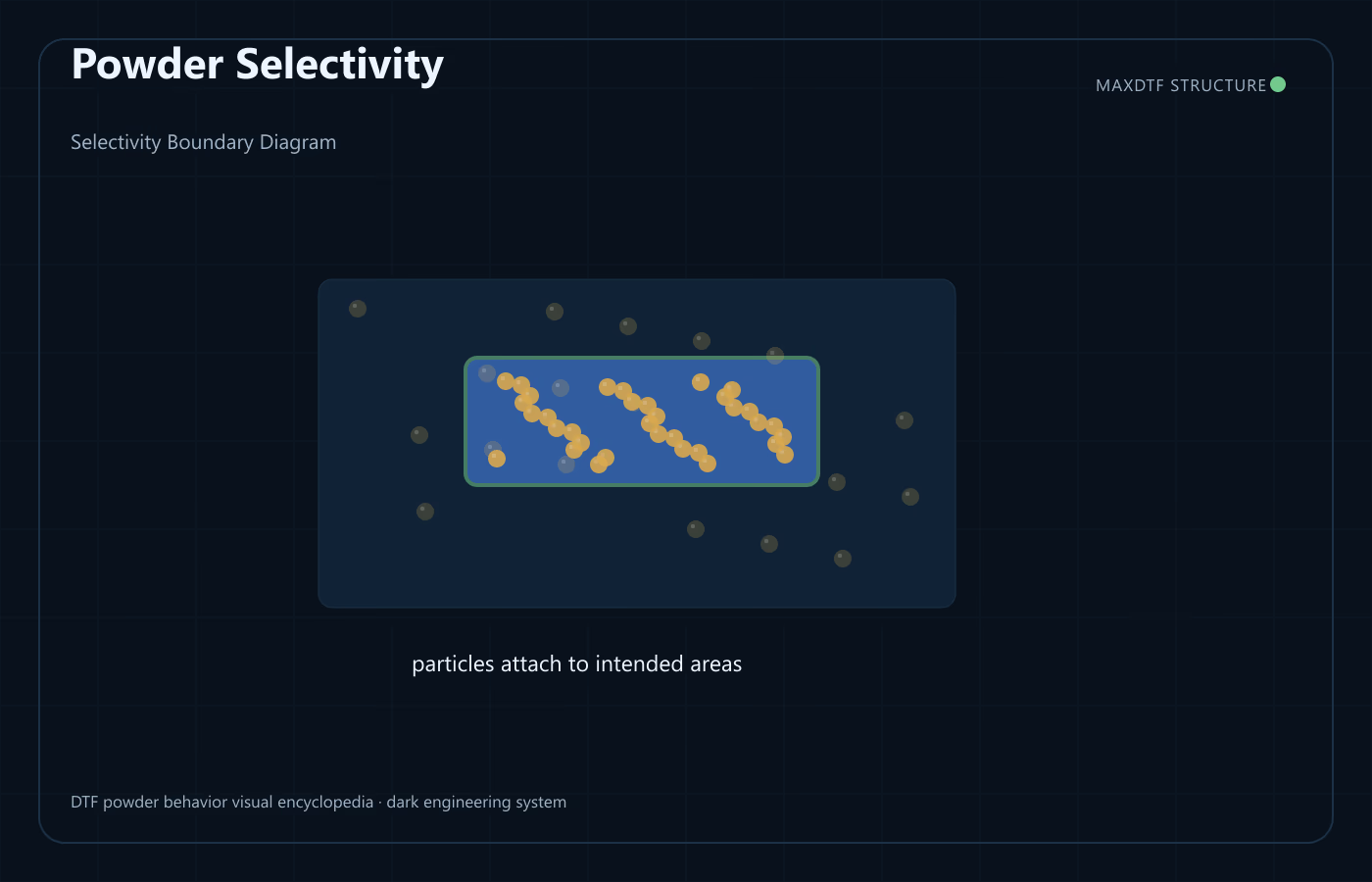
Powder selectivity refers to how selectively powder particles attach to intended printed areas within the DTF printing system.
It defines whether particles adhere only to inked regions or extend beyond them into unintended areas.
Powder selectivity is not a measure of bonding performance. It does not describe how strong the bond will be but rather how precisely particles are positioned during the attachment stage.
It is closely related to Powder Pickup, as pickup defines whether particles attach at all, while selectivity defines where that attachment occurs.
It also interacts with surface conditions described in Ink Behavior Architecture in DTF Printing, where ink coverage and surface characteristics determine how particles differentiate between areas.
How Powder Selectivity Functions in the DTF System
Within the DTF system, powder selectivity functions as a spatial control mechanism for particle attachment.
Particles are first distributed across the surface through Powder Distribution. However, distribution alone does not determine accuracy. Selectivity defines whether particles attach only where intended.
This means that selectivity governs the precision of powder placement relative to the printed image.
Selectivity is influenced by particle behavior and surface interaction. Powder Particle Size affects how easily particles can enter fine details, while Powder Flowability affects whether particles spread beyond intended regions.
It is also influenced by electrostatic conditions. Under certain conditions defined in Powder Electrostatics, particles may be attracted to or repelled from areas beyond the printed region, reducing selectivity.
Through these interactions, powder selectivity determines how accurately particle attachment reflects the intended design.
Interaction Path
Powder selectivity operates as a refinement stage within the powder behavior chain.
Particles are first positioned through Powder Distribution, which defines where particles are located.
Powder Pickup then determines which particles attach to the surface.
Powder selectivity further defines whether this attachment is spatially precise, ensuring that particles remain confined to intended regions.
Surface conditions defined in Ink Behavior Architecture in DTF Printing play a central role in this process, as they define how particles differentiate between printed and non-printed areas.
Environmental conditions described in Environmental Influence Architecture in DTF Printing further modify selectivity by influencing particle movement and interaction.
Through this sequence, powder selectivity defines the accuracy of particle attachment within the system.
What Powder Selectivity Does NOT Do
Powder selectivity does not define how particles melt, fuse, or form a bonding structure. These behaviors belong to Adhesive Bonding Architecture in DTF Printing.
It does not determine final adhesion strength or durability.
It does not define particle movement, which is described by Powder Flowability and Powder Distribution.
It does not define release or separation behavior, which are part of Release Timing Architecture in DTF Printing.
Powder selectivity is not a measure of quality but a condition of spatial control.
Structural Nature
Powder selectivity exists as a spatial precision condition within the Powder Behavior layer.
It does not belong to material composition or structural layers. Instead, it defines how accurately particles attach relative to printed geometry.
Its influence is expressed through how well particle attachment aligns with intended design areas.
Powder selectivity interacts with Powder Pickup by refining attachment behavior, with Powder Distribution by defining how placement translates into attachment, and with Powder Electrostatics by affecting unintended particle movement.
It does not define these variables individually but determines how precisely they operate together.
Performance Boundaries
Powder selectivity defines a balance between attachment sensitivity and spatial control.
Highly sensitive attachment may allow particles to adhere easily across all regions, reducing selectivity and increasing unintended attachment.
More controlled attachment may improve selectivity but reduce coverage in low-density or fine-detail areas.
This creates a range within which selectivity must operate to maintain both accurate placement and sufficient coverage.
Powder selectivity does not determine performance outcomes but defines whether particle attachment is spatially controlled.
Common Misunderstandings
Powder selectivity is often confused with bonding quality. In reality, selectivity defines attachment precision, not bonding strength.
Another common misunderstanding is treating selectivity as independent of pickup. In practice, selectivity depends on Powder Pickup, as attachment must occur before it can be controlled.
It is also often assumed that selectivity is controlled only by powder properties. In reality, it is strongly influenced by surface conditions defined in Ink Behavior Architecture in DTF Printing and environmental variables.
Selectivity is not a standalone variable but a result of multiple interacting factors.
Where Powder Selectivity Sits in the System
Powder selectivity belongs to the Powder Behavior layer of the DTF system.
It defines the precision stage of particle attachment, following distribution and pickup.
Within the system, it operates alongside Powder Distribution, Powder Pickup, and Powder Electrostatics, refining how particles attach to the surface.
Its effects propagate into later stages of the system, including bonding and separation processes described in System Interaction Architecture in DTF Printing.
Related Concepts
This concept is part of the Powder Behavior Architecture in DTF Printing system.
– Powder Flowability
– Powder Distribution
– Powder Pickup
– Powder Particle Size
– Powder Electrostatics
– Environmental Influence Architecture in DTF Printing
– Adhesive Bonding Architecture in DTF Printing
– Ink Behavior Architecture in DTF Printing
– Release Timing Architecture in DTF Printing