
Introduction
In DTF printing, adhesive powder must be applied as a distributed layer of discrete particles before any thermal activation or bonding occurs. Among all powder-related variables, distribution is the most direct expression of how powder exists on the printed surface.
Powder distribution is often interpreted as a visual outcome, such as whether powder appears even or uneven. In reality, it is not a result but a structural condition that defines how particles are positioned across the surface prior to transformation.
It does not define bonding quality or final print performance. Instead, it defines the spatial arrangement that determines how subsequent interactions take place.
Understanding powder distribution requires recognizing it as a positional framework that governs how particles occupy and interact with the printed layer.
What Is Powder Distribution
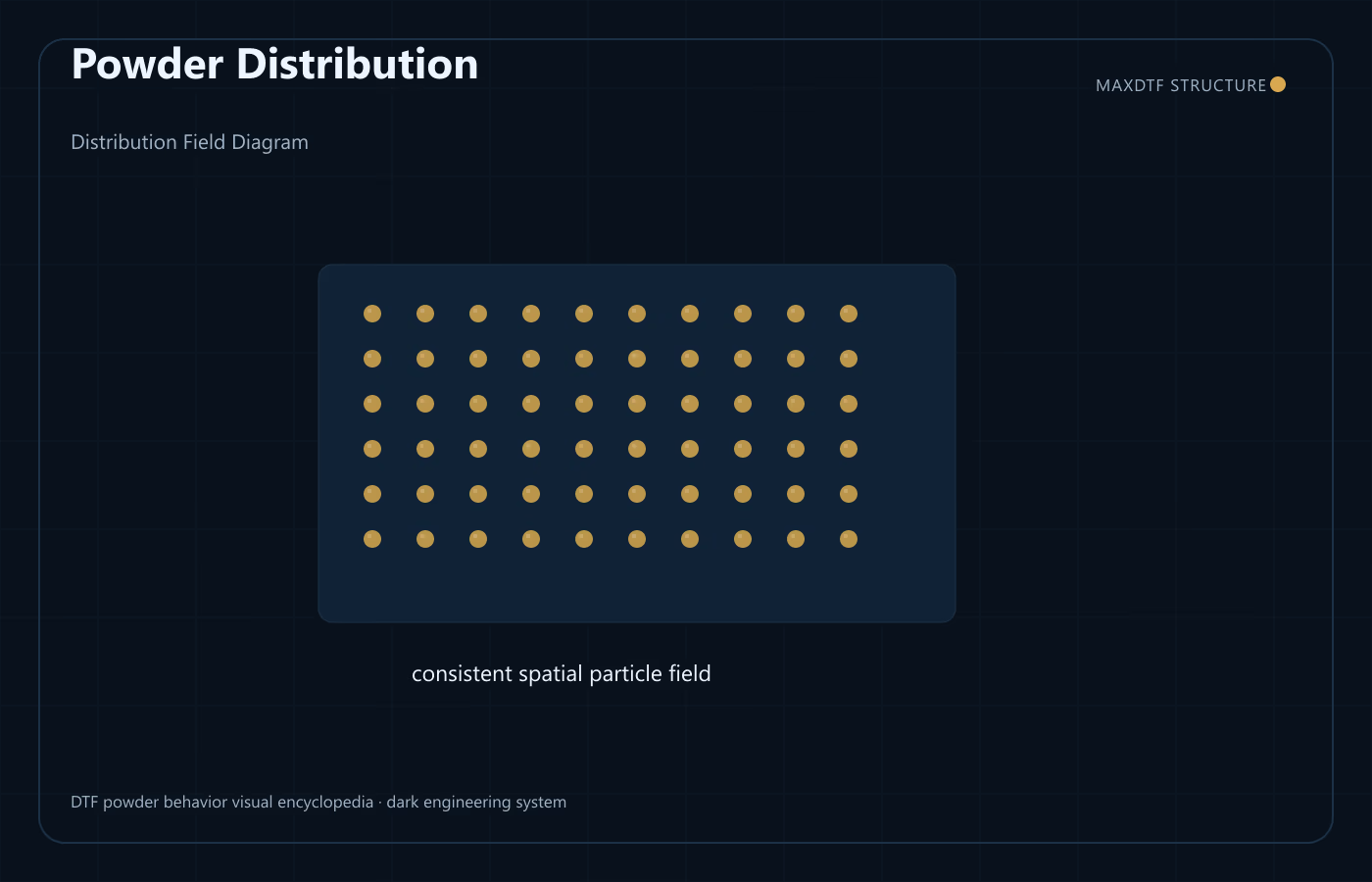
Powder distribution refers to the spatial arrangement of powder particles across a printed surface within the DTF printing system.
It defines where particles are located, how densely they occupy an area, and how consistently they are positioned relative to the printed geometry.
Powder distribution is not a measure of performance. It does not indicate bonding strength or final output quality. It defines the physical layout of particles prior to any thermal or bonding processes.
It is closely related to Powder Flowability, as the ability of particles to move determines how distribution can form.
It also interacts with Powder Pickup, since only particles that successfully attach contribute to the final distribution pattern.
How Powder Distribution Functions in the DTF System
Within the DTF system, powder distribution functions as the defining condition of particle placement.
It determines how particles cover the printed surface and whether coverage aligns with the intended geometry. This directly affects how consistently powder occupies inked areas and how well it follows the printed structure.
Distribution is influenced by how particles move across the surface. This connects it to Powder Flowability, which defines whether particles can spread and rearrange during application.
It is also influenced by particle scale. Powder Particle Size determines how densely particles can pack into a given area and how effectively they can follow fine details.
In addition, distribution depends on how particles attach to surfaces. If attachment is inconsistent, the resulting distribution will reflect those variations, linking distribution to Powder Pickup.
Environmental conditions further affect distribution behavior. Variations in airflow, humidity, and electrostatic charge can alter how particles settle and remain in place, connecting distribution to Environmental Influence Architecture in DTF Printing and Powder Electrostatics.
Through these interactions, powder distribution defines the spatial foundation upon which all subsequent powder behavior depends.
Interaction Path
Powder distribution operates as a central node in the powder behavior chain.
Particle movement determines how powder spreads, which is governed by Powder Flowability. This movement leads to a distribution pattern across the printed surface.
This distribution then defines where particles are available to interact with inked areas, influencing Powder Pickup.
Environmental variables modify this process. Under different conditions defined in Environmental Influence Architecture in DTF Printing, airflow, humidity, and electrostatic forces influence how particles are positioned and stabilized.
Once distribution is established, it directly affects how particles transition into bonding structures. The continuity and coverage of distribution influence how bonding occurs later, linking indirectly to Adhesive Bonding Architecture in DTF Printing.
Through this sequence, powder distribution defines the transition from particle movement to structural formation.
What Powder Distribution Does NOT Do
Powder distribution does not define how powder melts, fuses, or forms a bonding structure. These behaviors belong to Adhesive Bonding Architecture in DTF Printing.
It does not determine final adhesion strength, transfer quality, or durability.
It does not define ink behavior or surface chemistry, which are described in Ink Behavior Architecture in DTF Printing.
It does not define release or separation behavior, which are part of Release Timing Architecture in DTF Printing.
Powder distribution is not a direct indicator of system performance. It defines positioning conditions, not outcomes.
Structural Nature
Powder distribution exists as a spatial condition within the Powder Behavior layer of the DTF system.
It does not belong to material composition or structural layers. Instead, it defines how particles are arranged before transformation.
Its influence is expressed through how evenly and accurately particles occupy the printed surface.
Powder distribution interacts with Powder Flowability by determining how movement translates into coverage, with Powder Particle Size by defining spatial resolution, and with Powder Pickup by reflecting attachment behavior.
It does not define these variables individually but represents the combined result of their interaction.
Performance Boundaries
Powder distribution defines a balance between coverage completeness and positional stability.
Highly mobile particles may improve coverage but reduce positional control, leading to unstable distribution patterns. More stable particle behavior may improve consistency but limit the ability to achieve complete coverage in complex areas.
This creates a range within which distribution must operate to maintain both sufficient coverage and stability.
Powder distribution does not determine performance outcomes but defines whether the system operates within a stable spatial condition.
Common Misunderstandings
Powder distribution is often interpreted as a visual indicator of quality. In reality, it only describes how particles are positioned, not how they perform after activation.
Another common misunderstanding is treating distribution as equivalent to uniformity. Distribution defines where particles are located, while Powder Uniformity defines how consistent that distribution is.
It is also often assumed that distribution is controlled by a single variable. In practice, it results from the interaction of Powder Flowability, Powder Particle Size, and environmental conditions.
Distribution is not an independent variable but a combined expression of system interactions.
Where Powder Distribution Sits in the System
Powder distribution belongs to the Powder Behavior layer of the DTF system.
It defines the spatial condition of particles before thermal activation and bonding.
Within the system, it operates alongside Powder Flowability, Powder Particle Size, and Powder Pickup, forming the positional foundation of powder behavior.
Its effects propagate into later stages of the system, including bonding and separation processes described in System Interaction Architecture in DTF Printing.
Related Concepts
This concept is part of the Powder Behavior Architecture in DTF Printing system.
– Powder Flowability
– Powder Distribution
– Powder Pickup
– Powder Uniformity
– Powder Electrostatics
– Environmental Influence Architecture in DTF Printing
– Adhesive Bonding Architecture in DTF Printing
– Ink Behavior Architecture in DTF Printing
– Release Timing Architecture in DTF Printing