Introduction
In DTF printing, the presence of ink on the film is not defined only by its visual appearance, but also by its physical structure. One of the most fundamental structural attributes of the ink layer is its thickness.
Ink does not exist as an abstract surface condition. It exists as a measurable material layer positioned on DTF Film, forming part of the system’s physical structure.
Understanding Ink Layer Thickness requires defining it as a dimensional characteristic of DTF Ink, rather than interpreting it as a visual or performance-related concept. This concept is part of the Ink Behavior Architecture in DTF Printing system.
How Ink Layer Thickness Functions in the DTF System
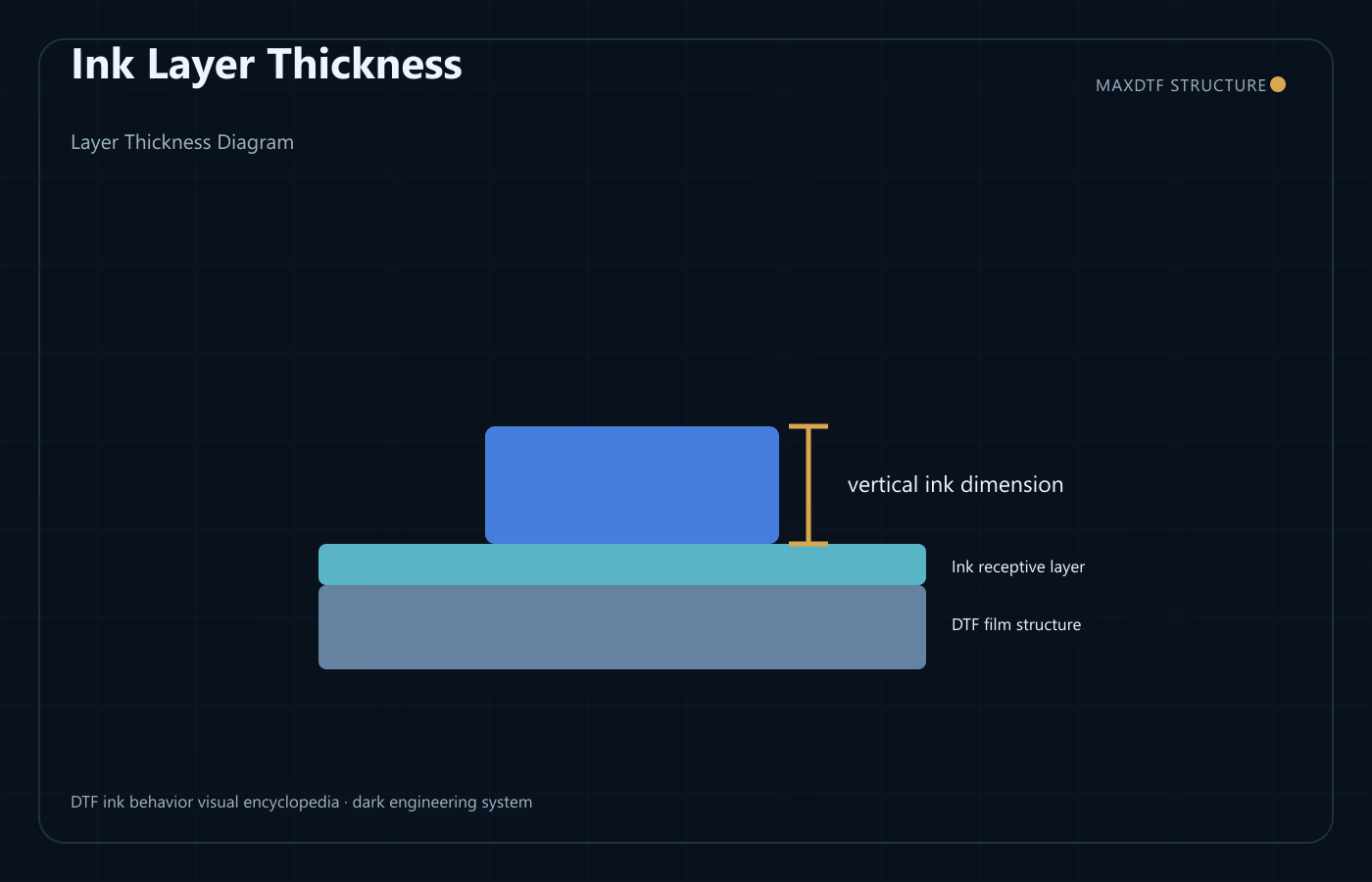
Within the system, Ink Layer Thickness defines the amount of material present above the Ink Receptive Layer.
It establishes the physical volume of DTF Ink that exists as a continuous or semi-continuous layer on the film surface.
This dimensional attribute determines the presence of the ink layer as a structural component within the overall DTF Film structure.
What Ink Layer Thickness Does NOT Do
Ink Layer Thickness does not control color vibrancy.
Ink Layer Thickness does not define edge sharpness or image resolution.
Ink Layer Thickness does not determine bonding behavior with DTF Adhesive Powder.
Ink Layer Thickness does not define separation behavior controlled by the Release Layer in DTF Film.
Ink Layer Thickness does not influence the mechanical properties of the Base PET Film.
Structural Nature
Ink Layer Thickness is a dimensional attribute of the DTF Ink layer within the film system.
It exists as a measurable vertical parameter and does not function as an independent material layer.
It is structurally dependent on how DTF Ink is deposited onto the Ink Receptive Layer, and remains confined within the surface structure of DTF Film.
Performance Boundaries
Ink Layer Thickness operates within defined boundaries such as minimum material presence and maximum structural stability of the ink layer.
Within these boundaries, the ink layer maintains its defined structural form as part of the system.
Outside these boundaries, the ink layer may no longer maintain a stable or continuous presence on the film surface.
Ink Layer Thickness does not extend beyond its role as a dimensional definition.
Common Misunderstandings
Ink Layer Thickness is often interpreted as a direct indicator of print quality.
In reality, it defines only the physical dimension of the ink layer and does not determine visual output or transfer results.
It is also commonly assumed that increasing thickness improves performance.
Ink Layer Thickness does not independently define system performance and must be understood as a structural parameter rather than a performance factor.
Where Ink Layer Thickness Sits in the System
Ink Layer Thickness exists within the DTF Ink layer, positioned above the Ink Receptive Layer and supported by the DTF Film structure.
It defines the vertical dimension of the ink layer at the interface between the film surface and the material that will later interact with DTF Adhesive Powder.
This concept is part of the Ink Behavior Architecture in DTF Printing system.