
Introduction
In DTF printing, ink does not initially exist as a continuous layer on the film surface. Instead, it is present as discrete material units that collectively form the image structure.
The transition from separated units to a unified layer introduces the concept of coalescence as a structural condition.
While thickness defines how much material exists, coverage defines how much surface is occupied, and distribution defines how ink is arranged, coalescence defines whether these material units exist as a continuous structure.
Understanding Ink Coalescence requires defining it as a structural state of the DTF Ink layer, rather than interpreting it as a process or a result. This concept is part of the Ink Behavior Architecture in DTF Printing system.
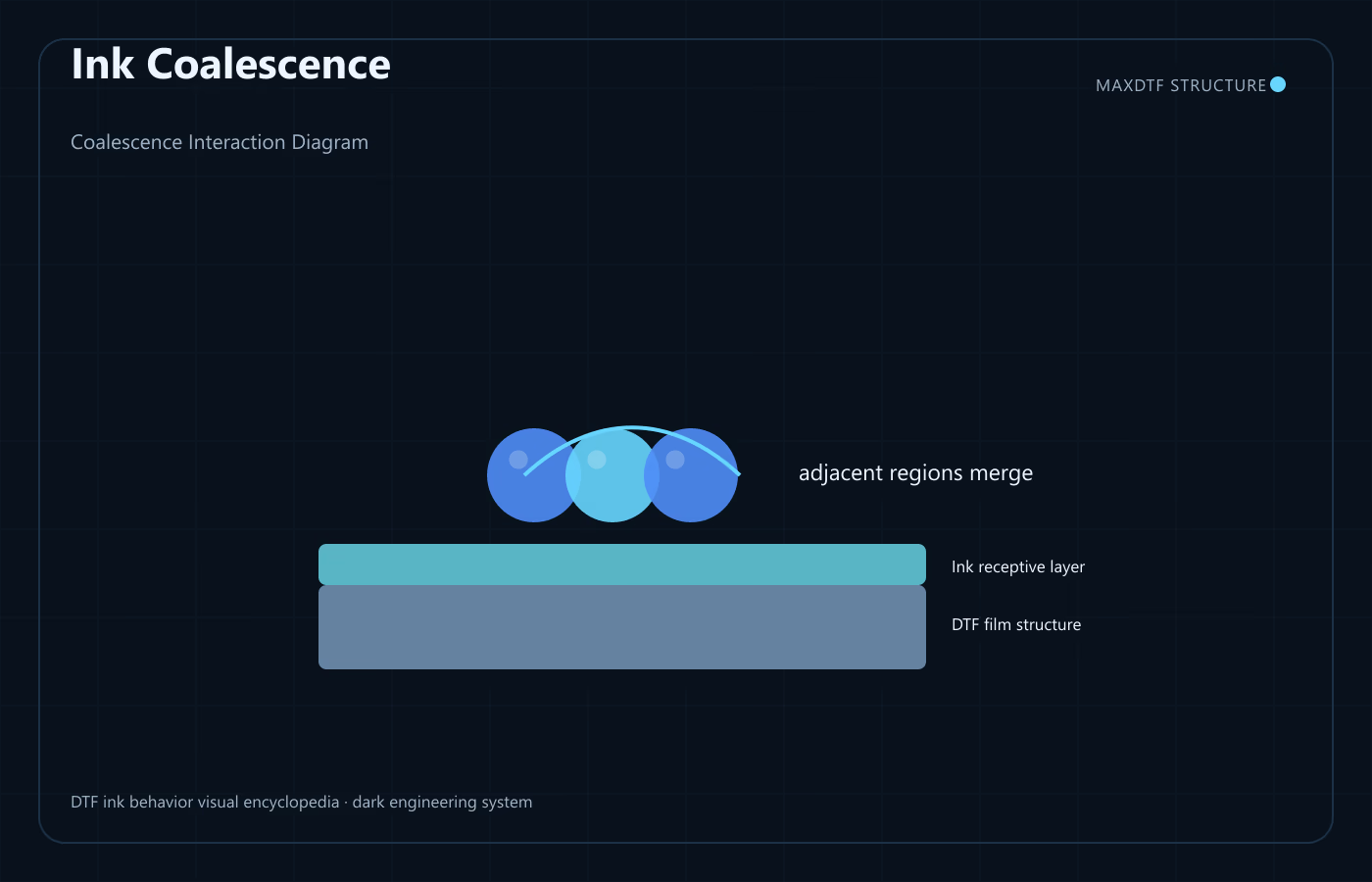
How Ink Coalescence Functions in the DTF System
Within the system, Ink Coalescence defines whether the DTF Ink layer exists as separate units or as a continuous structure across the Ink Receptive Layer.
It establishes the structural state of the ink layer at the surface of DTF Film, determining whether the material forms a unified presence or remains segmented.
This condition defines how the ink layer exists as part of the overall DTF Film structure, independent of its thickness, coverage, or spatial arrangement.
What Ink Coalescence Does NOT Do
Ink Coalescence does not define the thickness of the DTF Ink layer.
Ink Coalescence does not determine the total surface area occupied by ink.
Ink Coalescence does not define how ink is spatially arranged across the film.
Ink Coalescence does not control bonding behavior with DTF Adhesive Powder.
Ink Coalescence does not define separation behavior controlled by the Release Layer in DTF Film.
Ink Coalescence does not influence the mechanical properties of the Base PET Film.
Structural Nature
Ink Coalescence is a structural state attribute of the DTF Ink layer.
It exists as a condition that defines whether ink forms a continuous or discontinuous presence on the surface of DTF Film.
It is structurally dependent on how DTF Ink is positioned on the Ink Receptive Layer, and represents the connectivity of the ink layer rather than its quantity or extent.
Performance Boundaries
Ink Coalescence operates within defined boundaries such as discrete state and continuous state of the ink layer.
Within these boundaries, the ink layer exists either as separated units or as a unified structure.
Outside these boundaries, the structural definition of the ink layer may not remain consistent.
Ink Coalescence does not extend beyond defining the connectivity state of ink on the film surface.
Common Misunderstandings
Ink Coalescence is often misunderstood as a process that occurs during printing.
In reality, it is a structural condition that describes how the ink layer exists at a given state.
It is also commonly confused with surface coverage or distribution.
Coverage defines how much surface is occupied, distribution defines how ink is arranged, while coalescence defines whether the ink forms a continuous structure.
Ink Coalescence does not independently determine print performance or final transfer results.
Where Ink Coalescence Sits in the System
Ink Coalescence exists within the DTF Ink layer, positioned on the surface of DTF Film and above the Ink Receptive Layer.
It defines the structural connectivity of ink at the interface between the film surface and the material that will later interact with DTF Adhesive Powder.
This concept is part of the Ink Behavior Architecture in DTF Printing system.