
Introduction
In DTF printing, powder particles are expected to move, settle, and attach in a controlled manner. However, under certain conditions, particles may deviate from their intended path and disperse beyond the target area.
Powder scattering is often interpreted as a defect, such as powder flying or contaminating surrounding areas. In reality, it is a system-level condition that defines how particles respond to forces during movement and distribution.
It does not define bonding strength or final performance. Instead, it defines how particle trajectories deviate from controlled distribution before thermal activation.
Understanding powder scattering requires recognizing it as a movement instability condition influenced by multiple interacting variables.
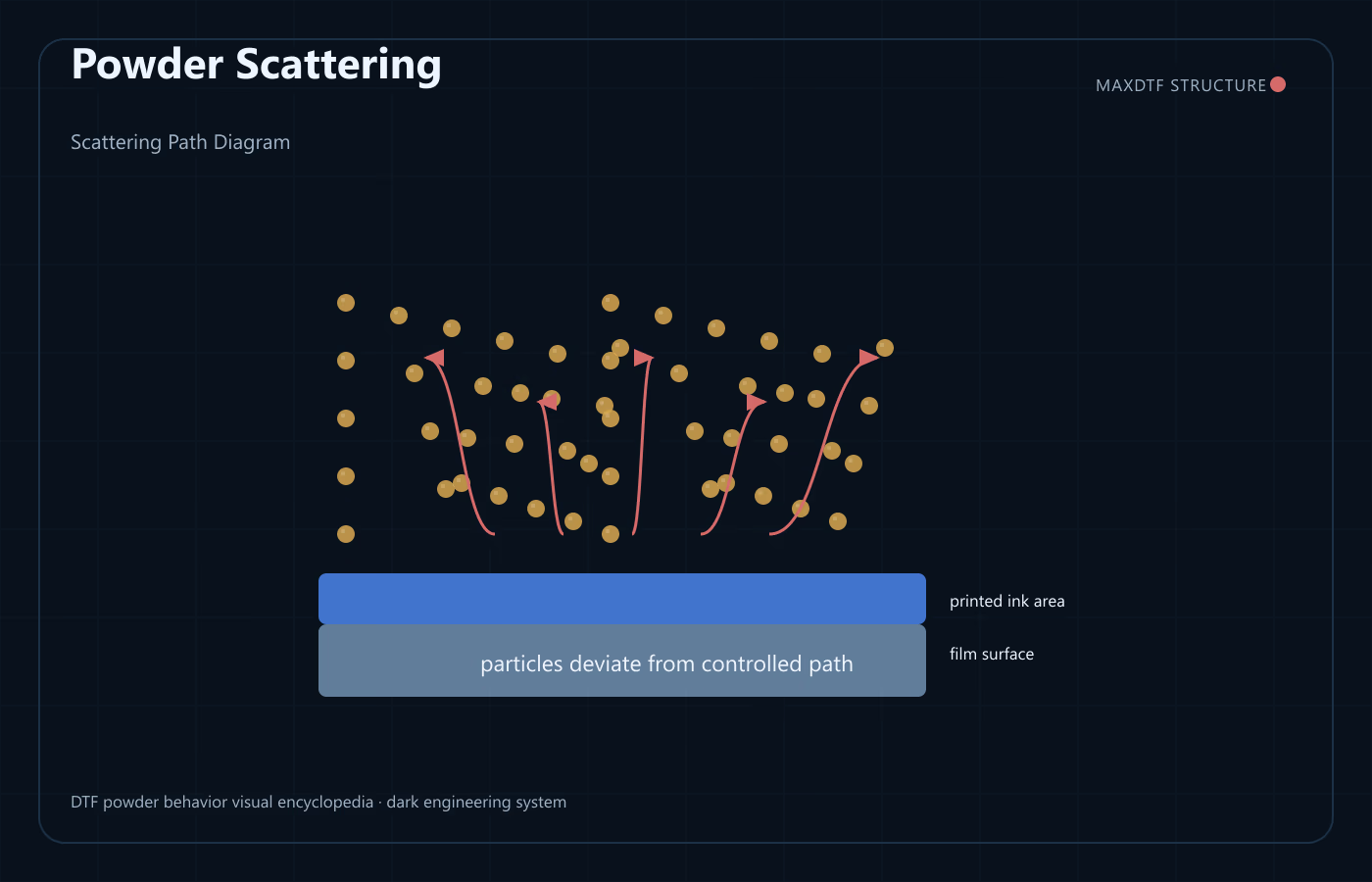
What Is Powder Scattering
Powder scattering refers to the uncontrolled dispersion or deviation of powder particles from their intended movement path within the DTF printing system.
It defines a condition in which particles move beyond the expected distribution area due to external or internal forces.
Powder scattering is not a performance metric. It does not directly describe bonding or final print quality. It defines how particle movement becomes unstable during the application stage.
It is closely related to Powder Flowability, as scattering represents an extension of particle movement behavior.
It also interacts with Powder Distribution, as scattered particles alter the intended spatial arrangement.
How Powder Scattering Functions in the DTF System
Within the DTF system, powder scattering functions as a deviation from controlled particle movement.
Particles are expected to move and settle based on Powder Flowability and surface interaction. When scattering occurs, particles move beyond their intended path, leading to unintended dispersion.
This directly affects Powder Distribution, as scattered particles create irregular coverage patterns.
Scattering also influences attachment behavior. Particles that deviate from their intended path may attach to unintended areas, affecting Powder Pickup and reducing spatial precision.
Powder scattering is strongly influenced by electrostatic forces. Under certain conditions defined in Powder Electrostatics, charged particles may be repelled or attracted in unpredictable ways, increasing movement instability.
Environmental conditions play a critical role. Variables such as airflow and humidity, defined in Environmental Influence Architecture in DTF Printing, can amplify or reduce scattering behavior.
Through these interactions, powder scattering defines how stable or unstable particle movement becomes within the system.
Interaction Path
Powder scattering emerges from particle movement and modifies distribution behavior.
Particles initially move across the surface through Powder Flowability, which defines baseline movement behavior.
Electrostatic forces and environmental conditions modify this movement, introducing instability that results in scattering.
This scattering alters Powder Distribution, as particles are no longer confined to intended areas.
It also affects Powder Pickup, as scattered particles may attach outside the printed region, reducing selectivity.
Through this sequence, powder scattering acts as a transformation from controlled movement to uncontrolled dispersion.
What Powder Scattering Does NOT Do
Powder scattering does not define how particles melt, fuse, or form a bonding structure. These behaviors belong to Adhesive Bonding Architecture in DTF Printing.
It does not determine final adhesion strength or durability.
It does not define surface chemistry or ink interaction, which are described in Ink Behavior Architecture in DTF Printing.
It does not define release or separation behavior, which are part of Release Timing Architecture in DTF Printing.
Powder scattering is not a defect but a condition of movement instability.
Structural Nature
Powder scattering exists as a movement instability condition within the Powder Behavior layer.
It does not belong to material structure or composition. Instead, it defines how particle trajectories deviate under the influence of forces.
Its influence is expressed through how particles move beyond intended paths.
Powder scattering interacts with Powder Flowability by extending movement behavior, with Powder Distribution by altering spatial patterns, and with Powder Electrostatics by responding to charge-related forces.
It does not define these variables individually but represents a deviation in their interaction.
Performance Boundaries
Powder scattering defines a balance between controlled movement and instability.
Under stable conditions, particle movement remains predictable, and scattering is limited.
Under unstable conditions, particles may deviate significantly, leading to widespread dispersion.
This creates a range within which particle movement must remain controlled to maintain stable system behavior.
Powder scattering does not determine performance outcomes but defines how predictable particle movement remains.
Common Misunderstandings
Powder scattering is often treated as a material defect. In reality, it is a condition arising from interaction between particle behavior and environmental variables.
Another common misunderstanding is assuming scattering is caused by a single factor. In practice, it results from the interaction of Powder Flowability, Powder Electrostatics, and environmental conditions.
It is also often assumed that scattering only affects movement. In reality, it affects both Powder Distribution and Powder Pickup, influencing how particles behave across the system.
Scattering is not an isolated issue but part of a broader interaction system.
Where Powder Scattering Sits in the System
Powder scattering belongs to the Powder Behavior layer of the DTF system.
It defines how particle movement becomes unstable before thermal activation.
Within the system, it operates alongside Powder Flowability, Powder Distribution, and Powder Electrostatics, influencing how particles move and interact.
Its effects propagate into later stages of the system, contributing to interactions described in System Interaction Architecture in DTF Printing.
Related Concepts
This concept is part of the Powder Behavior Architecture in DTF Printing system.
– Powder Flowability
– Powder Distribution
– Powder Pickup
– Powder Electrostatics
– Environmental Influence Architecture in DTF Printing
– Adhesive Bonding Architecture in DTF Printing
– Ink Behavior Architecture in DTF Printing
– Release Timing Architecture in DTF Printing