“DTG vs. DTF: Get the Transfer Sheet That Fits Your Needs!” -MAXDTF- DTF Transfer suppliers Manufacturer, DTF Foil Supplier, Made in China
In the realm of digital textile printing, Direct-to-Garment (DTG) and Direct-to-Film (DTF) with large transfer sheets are two prominent technologies, each tailored to specific production needs and applications. While both enable high-quality, full-color prints on fabrics, their core mechanisms, material compatibility, scalability, and performance characteristics differ significantly. Understanding these differences is crucial for businesses and hobbyists alike to make informed decisions about which technology aligns with their goals. Below is a detailed breakdown of the key distinctions between DTG and large-format DTF transfer sheets.
1. Core Printing Mechanism
The fundamental difference between DTG and large DTF transfer sheets lies in how the ink is applied to the fabric.
DTG printing is a direct-to-substrate process: the printer deposits water-based pigment inks directly onto the fabric (typically pre-treated with a solution to enhance ink adhesion and color vibrancy). The fabric then undergoes a curing process, either via a heat press or conveyor dryer, to set the ink into the fibers. This direct application means there is no intermediate transfer medium—ink interacts directly with the garment material.
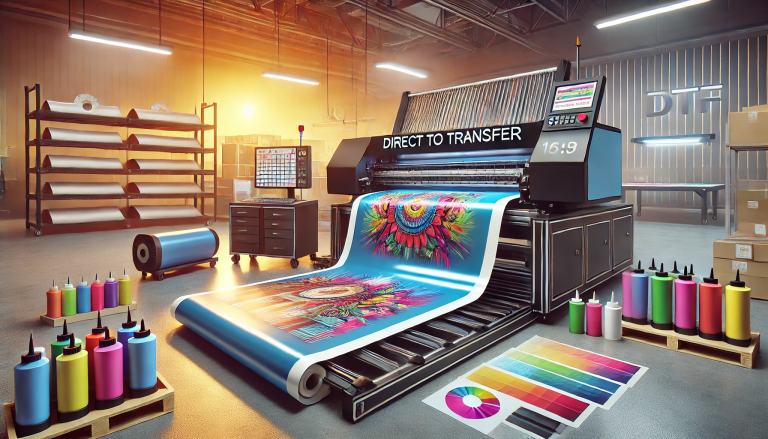
In contrast, large DTF transfer sheets rely on an indirect transfer process. First, water-based inks are printed onto a special PET film (the “transfer sheet”), followed by a layer of hot-melt adhesive. Once the ink and adhesive are dried or cured, the film is placed onto the fabric and activated with heat and pressure. The ink-adhesive layer detaches from the PET film and bonds permanently to the fabric. The “large” designation refers to the size of the PET film, which can accommodate larger print areas compared to standard DTF sheets.
2. Fabric Compatibility
Fabric type is a major determinant of which technology is suitable, as DTG and large DTF transfer sheets have distinct material requirements.
DTG printing performs best on 100% cotton or cotton-blend fabrics with a high cotton content (typically 50% or more). The water-based inks absorb into the cotton fibers, resulting in soft, breathable prints. DTG is less effective on synthetic fabrics (e.g., polyester, nylon) because synthetic fibers repel water-based inks, leading to poor adhesion, faded colors, and a stiff feel. While some DTG printers can handle light-colored synthetics with specialized inks, the results are often inferior to those on cotton.
Large DTF transfer sheets offer far broader fabric compatibility. They work with virtually all fabric types, including 100% cotton, polyester, blends, spandex, leather, and even non-woven materials. The hot-melt adhesive layer is the key to this versatility—it bonds to both natural and synthetic fibers, regardless of their absorbency. This makes DTF ideal for printing on performance wear (e.g., polyester athletic gear), swimwear, and other synthetic-based garments where DTG struggles. Additionally, DTF can be used on dark-colored fabrics without the need for a white underbase layer (though a white underbase may be used to enhance color vibrancy), whereas DTG often requires a white underbase for dark fabrics, adding complexity and cost.
3. Print Quality and Aesthetics
Both technologies produce high-resolution prints, but their aesthetic qualities—such as softness, color vibrancy, and detail reproduction—differ notably.
DTG prints are renowned for their soft hand feel. Since the ink absorbs into the fabric fibers rather than sitting on top, the print feels like part of the garment, not a separate layer. This makes DTG ideal for apparel where comfort is a priority, such as t-shirts, hoodies, and loungewear. DTG also excels at reproducing fine details, gradients, and photo-realistic images, as the direct ink application allows for precise color blending. However, color vibrancy on dark fabrics can be less intense compared to DTF, as the white underbase may slightly mute the top colors.
Large DTF transfer sheets produce prints with excellent color vibrancy, even on dark fabrics. The ink sits on top of the fabric (bonded by the adhesive), which allows colors to appear more saturated and bold. This is particularly advantageous for designs with bright, neon, or metallic tones. However, DTF prints have a slightly stiffer hand feel compared to DTG, especially for large or dense designs, as the adhesive layer adds a thin, tactile coating. While modern DTF inks and adhesives have become softer, the difference in feel is still noticeable. DTF also handles fine details well, though extremely intricate designs may experience minor edge blurring during the transfer process.
4. Scalability and Production Efficiency
Scalability—how well the technology adapts to small-batch vs. large-batch production—and production speed are critical factors for commercial applications.
DTG is optimized for small-batch, on-demand production. The setup process is relatively quick (requiring only fabric pre-treatment and printer calibration), making it ideal for custom orders, personalized apparel, or small runs (1–50 pieces). However, DTG printing is slow for large batches. Each garment must be printed individually, and the curing process adds additional time. For high-volume production (100+ pieces), DTG becomes inefficient and costly due to labor and time constraints.
Large DTF transfer sheets offer greater scalability, balancing both small-batch and large-batch needs. The initial step of printing on the PET film can be done in bulk—printers can produce multiple large transfer sheets at once, which can then be stored and used as needed. When it’s time to apply the prints, the transfer process is fast: a single heat press cycle (typically 10–30 seconds) is sufficient to bond the design to the fabric. This makes DTF ideal for large-scale production, as well as on-demand orders (since pre-printed transfer sheets can be stored and applied quickly). The “large” format also reduces the need for拼接 (piecing together multiple small transfers) for large designs, further improving efficiency.
5. Cost Considerations
The total cost of ownership and operation varies between DTG and large DTF transfer sheets, depending on production volume and setup requirements.
DTG has higher upfront costs: DTG printers are more expensive than DTF printers, and the pre-treatment solution (required for cotton fabrics) adds to material costs. For small batches, the per-unit cost is relatively low, as there is no need for additional transfer materials (e.g., PET film, adhesive). However, for large batches, the per-unit cost increases due to slow production speed and higher labor costs. DTG inks are also more expensive than DTF inks, which can impact long-term costs for high-volume users.
Large DTF transfer sheets have lower upfront costs: DTF printers are more affordable, and the PET film and adhesive are relatively inexpensive. The per-unit cost is lower for large batches, as the bulk printing of transfer sheets and fast application process reduce labor and material costs. For small batches, the per-unit cost may be higher than DTG, as the cost of the PET film and adhesive is spread over fewer units. However, the ability to store pre-printed transfer sheets reduces waste and improves cost efficiency for on-demand orders. Additionally, DTF does not require fabric pre-treatment, which eliminates the cost of pre-treatment solutions.
6. Durability and Wash Fastness
The durability of the print—how well it withstands repeated washing and wear—is another key difference.
DTG prints have good wash fastness on cotton fabrics, especially when properly cured. The ink is embedded in the fibers, so it resists fading and peeling for 50+ washes (depending on the ink quality and curing process). However, DTG prints on blends or synthetic fabrics may have reduced durability, as the ink does not bond as effectively to non-cotton fibers.
Large DTF transfer sheets offer excellent durability on all fabric types. The hot-melt adhesive creates a strong bond between the ink and the fabric, resulting in prints that withstand 50+ washes without fading, peeling, or cracking. DTF prints are also more resistant to abrasion, as the adhesive layer protects the ink from direct contact with surfaces. This makes DTF ideal for garments that undergo frequent washing or heavy wear, such as workwear, athletic gear, and children’s clothing.
Conclusion
In summary, DTG and large DTF transfer sheets are distinct digital textile printing technologies with unique strengths and limitations. DTG excels at small-batch, soft-feel prints on cotton fabrics, making it ideal for custom apparel and personalized items where comfort and fine detail are priorities. Large DTF transfer sheets, on the other hand, offer broad fabric compatibility, vibrant colors, scalability for large batches, and excellent durability, making them suitable for a wide range of applications—from performance wear to large-format designs. The choice between the two depends on factors such as fabric type, production volume, desired aesthetic, and budget. By understanding these key differences, users can select the technology that best meets their specific needs.