Introduction
In DTF printing, peel timing is often described using familiar terms such as hot peel, warm peel, or cold peel.
These terms are useful for describing observable separation behavior, but they can also create a simplified understanding of release performance. They may suggest that release behavior belongs to one fixed timing category, when the actual system response is produced by multiple interacting conditions.
All Time Peel refers to a release timing architecture designed to maintain release consistency across a wider peel timing range than traditional peel classifications.
It does not describe a single peel temperature, a product claim, or a fixed operating instruction. Instead, it describes a system condition in which the release structure, thermal behavior, adhesion balance, and separation interface remain compatible across a broader range of timing states.
Within the DTF system, All Time Peel should be understood as a timing flexibility concept. It is closely associated with Peel Window, Release Timing, Release Readiness State, and Release Stability.
Understanding All Time Peel requires looking beyond isolated peel categories and examining how system interaction creates stable separation behavior.
What Is All Time Peel
All Time Peel is a release timing architecture in which separation behavior remains consistent across a wider timing range.
It describes the ability of the DTF system to support stable peeling under multiple timing conditions rather than only within a narrow hot, warm, or cold peel classification.
In this context, “all time” does not mean that peeling can occur under any condition without limitation. It means that the release system is structured to maintain separation readiness across a broader range of thermal and temporal states.
All Time Peel is influenced by:
– release layer behavior
– thermal transition behavior
– adhesive cohesion
– ink and adhesive interaction
– surface energy balance
– separation force distribution
This concept should not be interpreted as a simple feature or instruction. It is a system-level release timing concept.
All Time Peel exists when the release interface can remain stable enough to support separation across different timing states. This requires coordination between Release Layer Definition, Release Surface Energy, Release Activation State, and Release Readiness State.
In DTF printing, release behavior is not produced by timing alone. Timing interacts with material state, heat retention, layer formation, adhesive bonding, and separation mechanics.All Time Peel defines a broader timing architecture, not a single peel method.
Why All Time Peel Exists In DTF Systems
All Time Peel exists because DTF separation does not occur at one fixed moment in every production condition.
During production, the printed transfer passes through a sequence of thermal and structural changes. Ink layers form, adhesive particles melt or fuse, bonding states develop, and the release interface changes as heat moves through the system.
These transitions do not always reach the same state at the same time.
A narrow peel system may require separation to occur within a limited timing range. If peeling occurs too early, the system may not have reached sufficient Release Readiness State. If peeling occurs too late, the interface may shift toward a different release condition, affecting Release Force Profile or Release Completeness.
All Time Peel exists to describe a broader timing condition where the system remains compatible with stable separation across more than one peel moment.
This does not remove the need for system control. Instead, it means the release architecture is less dependent on a single narrow timing point.
The concept is important because DTF production involves variation. Heat retention may differ across film areas. Adhesive melting may progress unevenly. Cooling behavior may vary depending on material thickness, layer structure, and environmental conditions. These changes can influence when the system becomes ready for separation.
All Time Peel is therefore not an isolated release label. It represents a system response to timing variation.It connects upstream conditions such as Thermal Process Stability, Release Layer Architecture, and Layer Interaction Consistency with downstream outcomes such as Release Uniformity, Release Stability, and Peel Window behavior.
What Influences All Time Peel
All Time Peel is influenced by several upstream system variables.
The first influence is release layer structure. The release layer must define a separation interface that can remain functional across different thermal states. If Release Layer Definition is weak or inconsistent, the system may only separate properly within a narrow condition range.
The second influence is release surface energy. Release Surface Energy affects how strongly the printed structure interacts with the film surface. If surface energy is too strongly biased toward retention or separation, release behavior may become unstable outside a limited timing state.
The third influence is thermal behavior. DTF systems pass through heating, holding, cooling, and peeling stages. Heat Retention, Temperature, and Ambient Thermal Stability can influence how long the system remains within a stable release condition. A system with uneven thermal behavior may show different release responses at different peel moments.
The fourth influence is adhesive state. Concepts such as Adhesive Melted State, Adhesive Fusion State, Adhesive Bonding State, and Adhesive Wetting State affect whether the transferred structure has enough internal cohesion and fabric-side bonding support during separation.
The fifth influence is ink and adhesive interaction. Ink Layer Formation, Ink Film Continuity, and Adhesive Layer Continuity affect how the printed structure behaves as a single transfer layer. If the layer system lacks continuity, a wider peel timing range may not produce consistent release.
The sixth influence is force distribution. Release Force Profile determines how separation forces move across the interface. If force distribution changes sharply across timing states, release may become uneven or incomplete.
All Time Peel is therefore determined by the interaction of release architecture, thermal behavior, adhesive state, layer continuity, and separation mechanics.
It is not created by timing alone.
What Does All Time Peel Influence
All Time Peel influences how the DTF system responds to timing variation during separation.
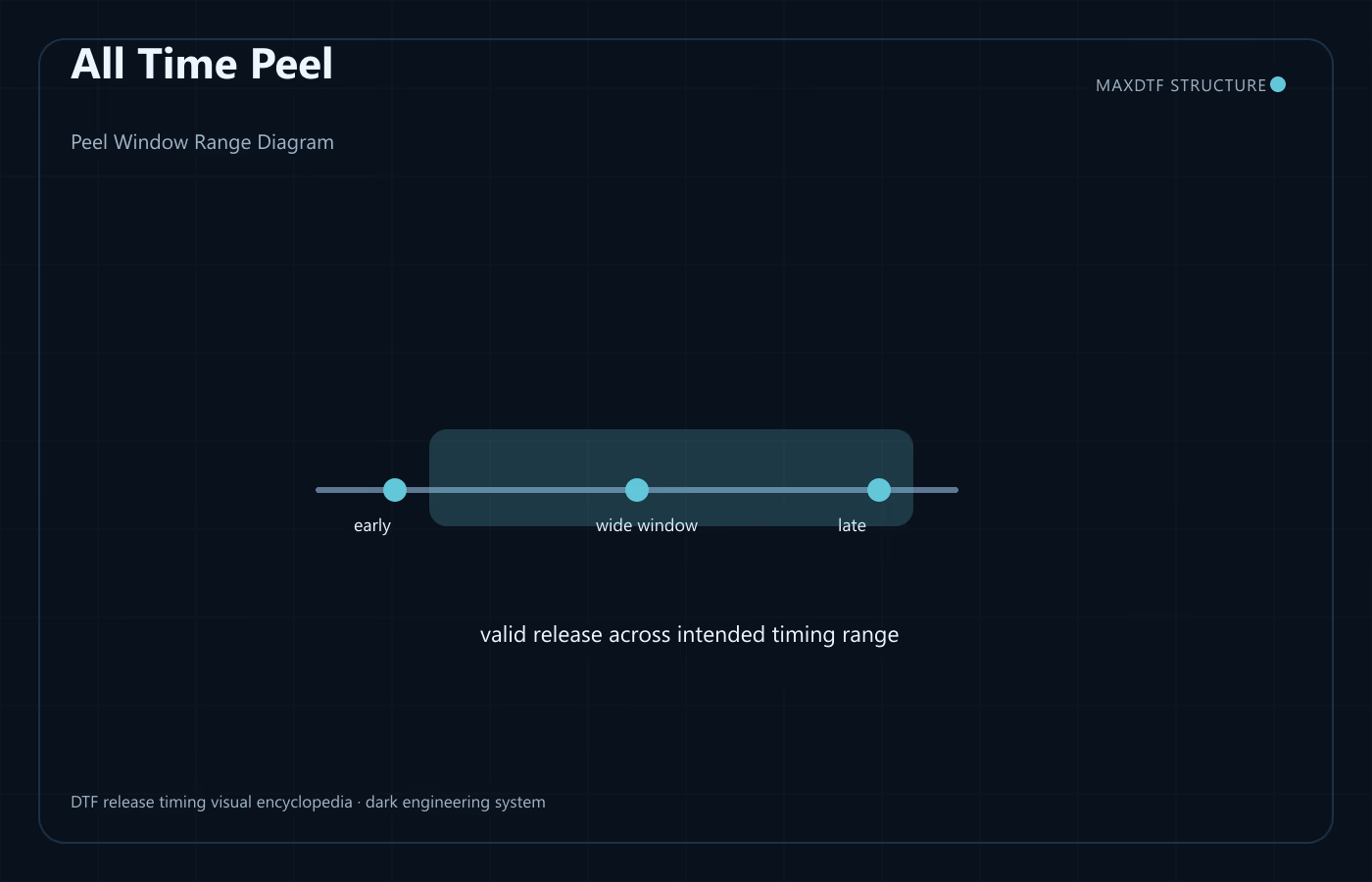
Its most direct influence is on Peel Window. A wider peel window means the system can support stable separation across a broader range of timing states. All Time Peel describes the architecture that allows this window to expand without relying on only one peel classification.
It also influences Release Timing. In a narrow timing system, release behavior may depend heavily on peeling at a specific moment. In an All Time Peel architecture, release timing remains important, but the system is less sensitive to small timing differences.
All Time Peel can also influence Release Stability. When release behavior remains consistent across different timing states, the system is more likely to produce repeatable separation behavior over repeated production cycles.
It affects Release Uniformity because timing variation can produce uneven separation across the printed surface. If one area cools faster than another, or if one section retains heat longer, a narrow release system may separate unevenly. A broader release timing architecture can reduce the influence of these timing differences.
All Time Peel also relates to Release Completeness. Incomplete release may occur when the system is peeled before readiness is achieved or after the interface has shifted outside its stable range. A broader release condition can support more complete separation across variable timing states.
However, All Time Peel does not independently guarantee transfer quality. It does not define ink density, adhesive coverage, powder behavior, or final fabric bonding by itself.
It influences release consistency by expanding timing compatibility within the release system.
The downstream effects of All Time Peel should be understood as system-level consequences, not isolated performance claims.
Relationship With Other DTF Concepts
All Time Peel is closely connected to multiple L3 concepts within the DTF system.
It is directly associated with Peel Window because both concepts describe timing range. However, they are not identical. Peel Window describes the range in which peeling can occur with stable behavior. All Time Peel describes the release timing architecture that supports a wider functional range.
It is also connected to Release Timing. Release Timing describes when separation occurs relative to system state. All Time Peel describes how the system maintains release compatibility across more than one timing condition.
All Time Peel depends on Release Activation State because separation must first become physically possible. If activation has not occurred, a wider timing architecture cannot support stable release.
It also depends on Release Readiness State. Activation alone does not mean the system is prepared for controlled separation. All Time Peel requires readiness to be maintained across a broader timing range.
The concept interacts with Release Force Profile because separation force may change as the system transitions from hotter to cooler states. A stable force profile helps support consistent peeling across timing variation.
All Time Peel also relates to Thermal Process Stability. Thermal behavior influences how quickly the printed structure enters, remains within, and exits the release-ready condition.
It connects with Layer Interaction Consistency because the ink, adhesive, powder, and film must behave as an integrated structure during separation.
Finally, it is associated with Structural Balance In DTF Systems. A wider peel timing range requires balance between retention and separation, adhesion and release, flexibility and cohesion.
All Time Peel sits at the intersection of release timing, thermal transition, layer interaction, and separation stability.
Relationship To Manufacturing Stability
All Time Peel contributes to manufacturing stability by reducing dependence on a narrow peel moment.
In production environments, timing variation is difficult to eliminate completely. Operators may peel at slightly different intervals. Printed areas may cool at different rates. Film rolls may experience small variations in heat exposure, airflow, or handling time. These differences can influence release behavior.
A system with a narrow timing response may produce inconsistent results when these small variations occur.
All Time Peel addresses this issue at the system level. It supports a broader condition in which separation can remain stable, uniform, and repeatable.
This directly reflects the manufacturing-first view of DTF printing. Stable production is not created only by one parameter or one material property. It is created by the interaction of film structure, release layer behavior, adhesive state, thermal response, and separation mechanics.
From a Film First perspective, the film is not a passive carrier. It participates in defining the release interface, timing range, and separation behavior. When the film structure supports stable release across a wider timing range, the system becomes less sensitive to normal production variation.
All Time Peel therefore contributes to manufacturing consistency by improving timing tolerance within the release system.
It can support repeatability across:
– different peel timing states
– repeated production cycles
– variable cooling behavior
– different transfer sizes
– changing environmental conditions
However, this does not mean process control becomes unnecessary. Manufacturing stability still depends on controlled materials, stable thermal behavior, consistent layer formation, and predictable separation mechanics.
All Time Peel should be viewed as one system variable within manufacturing stability, not as a replacement for system control.
Why All Time Peel Should Be Viewed As A System Variable
All Time Peel should be viewed as a system variable because it is produced by interaction between multiple conditions.
It is not only a film label. It is not only a peel method. It is not only a timing instruction.
The behavior described by All Time Peel emerges when several parts of the DTF system remain compatible across a wider timing range.
The upstream variables include:
– release layer structure
– surface energy balance
– thermal transition behavior
– ink layer formation
– adhesive fusion and bonding state
– force distribution during separation
These variables shape the current concept: All Time Peel.
The downstream effects include:
– wider Peel Window
– more consistent Release Timing behavior
– improved Release Uniformity across timing variation
– stronger Release Stability across repeated conditions
– more predictable Release Completeness
This relationship can be understood as:
“`text
UPSTREAM VARIABLES
↓
ALL TIME PEEL
↓
DOWNSTREAM RELEASE BEHAVIOR
“`
If All Time Peel is treated as an isolated property, the system logic becomes unclear. It may be misunderstood as a universal peel instruction or as a guarantee that timing no longer matters.
In reality, All Time Peel depends on whether the system can preserve release readiness across thermal and temporal variation.
This is why the concept belongs in L3. It explains multiple visible outcomes, connects with multiple related concepts, exists independently of a specific product, and represents a system variable rather than a symptom.
DTF performance is produced by system interaction rather than isolated variables.
All Time Peel is one example of that principle.
What All Time Peel Does NOT Do
All Time Peel does not define a specific film product.
All Time Peel does not recommend a brand, supplier, or purchasing decision.
All Time Peel does not define exact temperature, pressure, time, or machine parameters.
All Time Peel does not replace Peel Mode. Peel Mode classifies observable separation behavior, while All Time Peel describes a broader timing architecture.
All Time Peel does not mean peeling can occur under any possible condition.
All Time Peel does not mean that release behavior is independent of thermal state.
All Time Peel does not independently determine transfer quality.
All Time Peel does not define whether the separation interface exists. That condition relates to Release Layer Definition.
All Time Peel does not define interfacial energy by itself. That condition relates to Release Surface Energy.
All Time Peel does not define whether separation has become possible. That condition relates to Release Activation State.
All Time Peel does not define whether separation is ready to proceed in a controlled manner. That condition relates to Release Readiness State.
All Time Peel does not define final adhesion to fabric. That depends on adhesive behavior, bonding state, and the broader transfer system.
All Time Peel should be understood as timing flexibility within a controlled release architecture.
Where All Time Peel Sits in the System
All Time Peel belongs to the Release Timing Architecture in DTF Printing.
It sits between peel classification and release stability.
Within the system, it connects:
– timing range behavior (Peel Window)
– release timing behavior (Release Timing)
– readiness behavior (Release Readiness State)
– separation mechanics (Release Force Profile)
– consistency outcomes (Release Uniformity, Release Stability, Release Completeness)
All Time Peel functions as a timing flexibility concept. It explains how a DTF release system can remain stable across different peel timing states.
It does not belong only to hot peel, warm peel, or cold peel categories.
Instead, it describes the system architecture that allows release behavior to remain compatible across a broader timing range.
Parent Cluster
Release Timing Architecture in DTF Printing
Related Concepts
Neighbor Concepts
Conclusion
All Time Peel is a system-level release timing concept in DTF printing.
It describes a release timing architecture designed to maintain separation consistency across a wider peel timing range than traditional peel classifications.
The concept should not be understood as a product claim, a process recipe, or a replacement for system control. It should be understood as the result of interaction between release layer structure, surface energy, thermal behavior, adhesive state, layer continuity, and separation force behavior.
All Time Peel helps explain why some DTF systems can remain stable across broader timing variation, while others require a narrower peel moment.
As an L3 concept, it connects upstream variables with downstream release behavior.
A strong understanding of All Time Peel supports the broader principle that DTF performance is produced by system interaction rather than isolated variables.