
Introduction
In DTF printing, ink deposited onto the film surface does not exist only as a visible layer. Part of the ink exists in relation to the surface structure of the film, forming a defined state within the material system.
While structural parameters such as Ink Layer Thickness and Ink Surface Coverage describe how ink is present on the film, they do not define how the ink exists in relation to the internal structure of the Ink Receptive Layer.
This condition is defined as the Ink Absorption State.
Ink Absorption State is often described in terms of how ink penetrates or moves into the film surface. However, such descriptions refer to process interpretation rather than the definition of the concept.
Within the DTF system, Ink Absorption State must be understood as a defined condition that describes how DTF Ink exists in relation to the structure of the Ink Receptive Layer, independent of process description.
Understanding this concept requires separating structural presence from internal positioning within the film system.
What Is Ink Absorption State
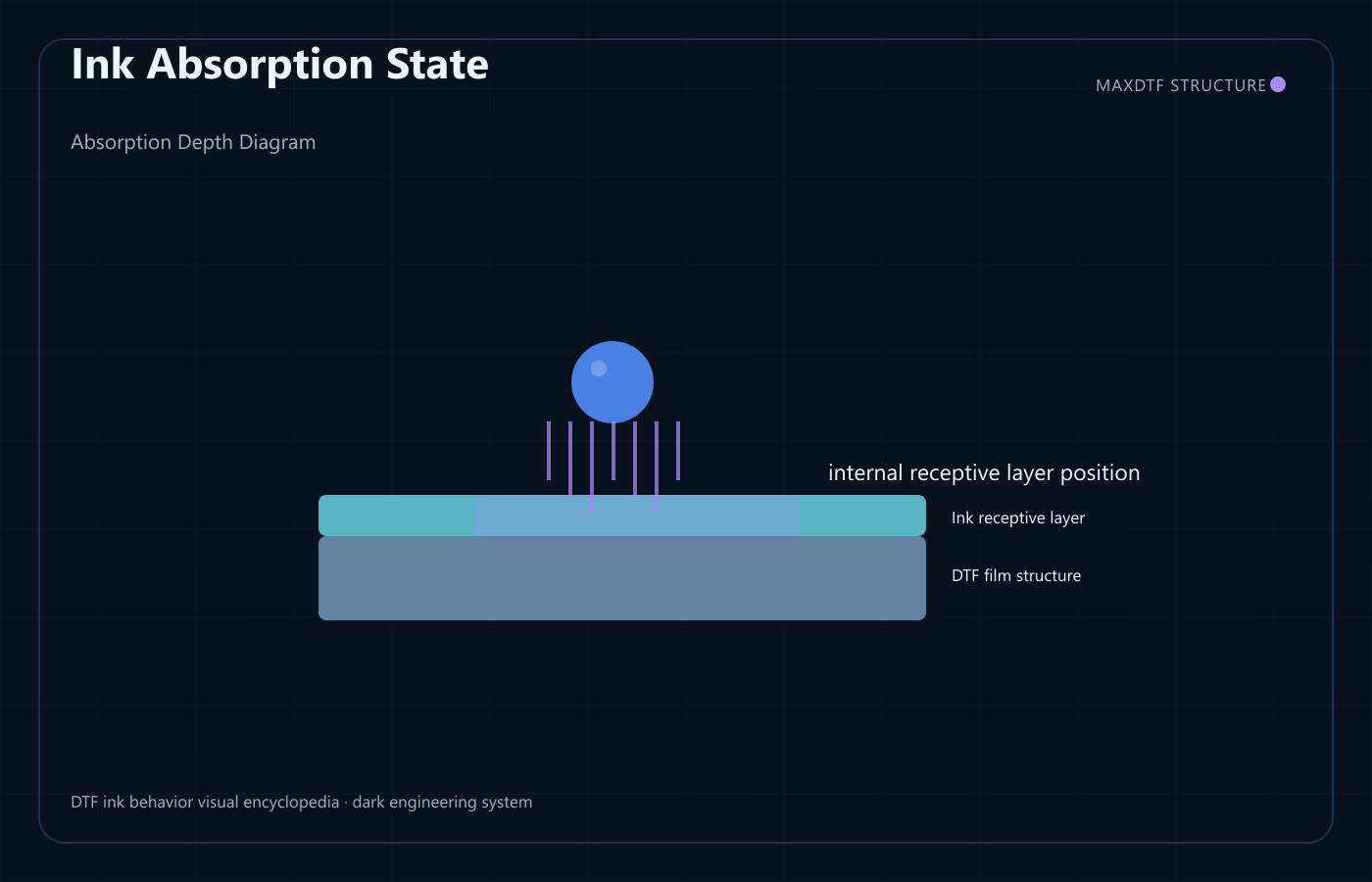
Ink Absorption State is the internal condition that defines how DTF Ink exists within the structure of the Ink Receptive Laye on DTF Film within the DTF system.
How Ink Absorption State Functions in the DTF System
Within the system, Ink Absorption State defines how the DTF Ink layer is positioned relative to the structure of the Ink Receptive Layer.
It describes whether the ink exists at the surface level, within the upper structure, or within the internal structure of the layer.
This concept defines the internal positioning of ink within the film system, rather than the external structure of the ink layer.
Ink Absorption State operates alongside interfacial conditions such as Ink Wetting State and Ink Adhesion State, but remains distinct in definition.
It also differs from structural parameters such as Ink Coalescence and Ink Film Continuity, which define how ink exists as a structure on the surface.
Ink Absorption State defines where ink exists within the layer structure, not how it is arranged or connected.
What Ink Absorption State Does NOT Do
Ink Absorption State does not define the thickness of the DTF Ink layer.
Ink Absorption State does not determine the total surface area occupied by ink.
Ink Absorption State does not define how ink is spatially distributed across DTF Film.
Ink Absorption State does not define the intrinsic properties of DTF Ink, including Ink Surface Tension.
Ink Absorption State does not define the interfacial conditions described by Ink Wetting State or Ink Adhesion State.
Ink Absorption State does not define the structural connectivity described by Ink Coalescence.
Ink Absorption State does not define the overall structural completeness described by Ink Film Continuity.
Ink Absorption State does not define bonding behavior with DTF Adhesive Powder.
Ink Absorption State does not control separation behavior defined by the Release Layer in DTF Film.
Ink Absorption State does not define the mechanical properties of the Base PET Film.
Ink Absorption State does not independently define system performance or visual outcomes.
Structural Nature
Ink Absorption State is an internal positional condition of DTF Ink within the structure of the Ink Receptive Layer.
It does not describe the surface structure of the ink layer, nor does it define intrinsic properties of the ink material.
Instead, it defines how the ink exists within the internal structure of the film’s functional coating layer.
This concept is not a dimensional parameter and does not define thickness, area, or position across the surface.
It is also not a material property.
Ink Absorption State exists as a layer-internal definition that describes the positioning of ink within the coating structure of DTF Film.
Performance Boundaries
Ink Absorption State operates within defined boundaries of internal positioning consistency.
Within these boundaries, DTF Ink maintains a defined and stable positional relationship within the structure of the Ink Receptive Layer.
These boundaries define the range within which the internal positioning of ink remains consistently defined.
Outside these boundaries, the positional condition of ink may no longer remain consistently defined.
These boundaries do not represent performance outcomes, but define the limits within which the concept remains valid as a system definition.
Ink Absorption State does not extend beyond defining the internal positioning of ink within the layer.
Common Misunderstandings
Ink Absorption State is often interpreted as the process by which ink penetrates into the film.
In reality, it defines the condition of ink positioning within the layer, not the process that leads to that condition.
It is also commonly misunderstood as being equivalent to Ink Wetting State.
Ink Wetting State defines the condition of contact at the surface, while Ink Absorption State defines the internal positioning of ink within the layer structure.
Another common misunderstanding is that absorption state determines bonding behavior.
Within the DTF system, it exists as a positional definition and does not independently define system performance or outcomes.
Where Ink Absorption State Sits in the System
Ink Absorption State exists within the structure of the Ink Receptive Layer on DTF Film .
It is positioned below the surface interface where Ink Wetting State and Ink Adhesion State are defined.
Within the system, it defines how DTF Ink exists inside the layer structure, forming part of the internal definition of the ink layer.
Related Concepts
DTF Ink
DTF Film
Ink Receptive Layer
Ink Surface Tension
Ink Layer Thickness
Ink Surface Coverage
Ink Spatial Distribution
Ink Coalescence
Ink Film Continuity
DTF Adhesive Powder
This concept is part of the Ink Behavior Architecture in DTF Printing system.