
Introduction
In DTF printing, powder must not only be distributed across the printed surface, but also remain consistent in how it is applied. This consistency defines whether the system behaves uniformly across different areas.
Powder uniformity is often interpreted as a visual condition, such as whether powder appears even or uneven. In reality, it is a system-level condition that defines how consistently particles are distributed and attached across the surface.
It does not define bonding strength or final performance. Instead, it defines whether particle behavior remains consistent across the system before thermal activation.
Understanding powder uniformity requires recognizing it as a consistency condition that governs how evenly particle behavior is maintained.
What Is Powder Uniformity
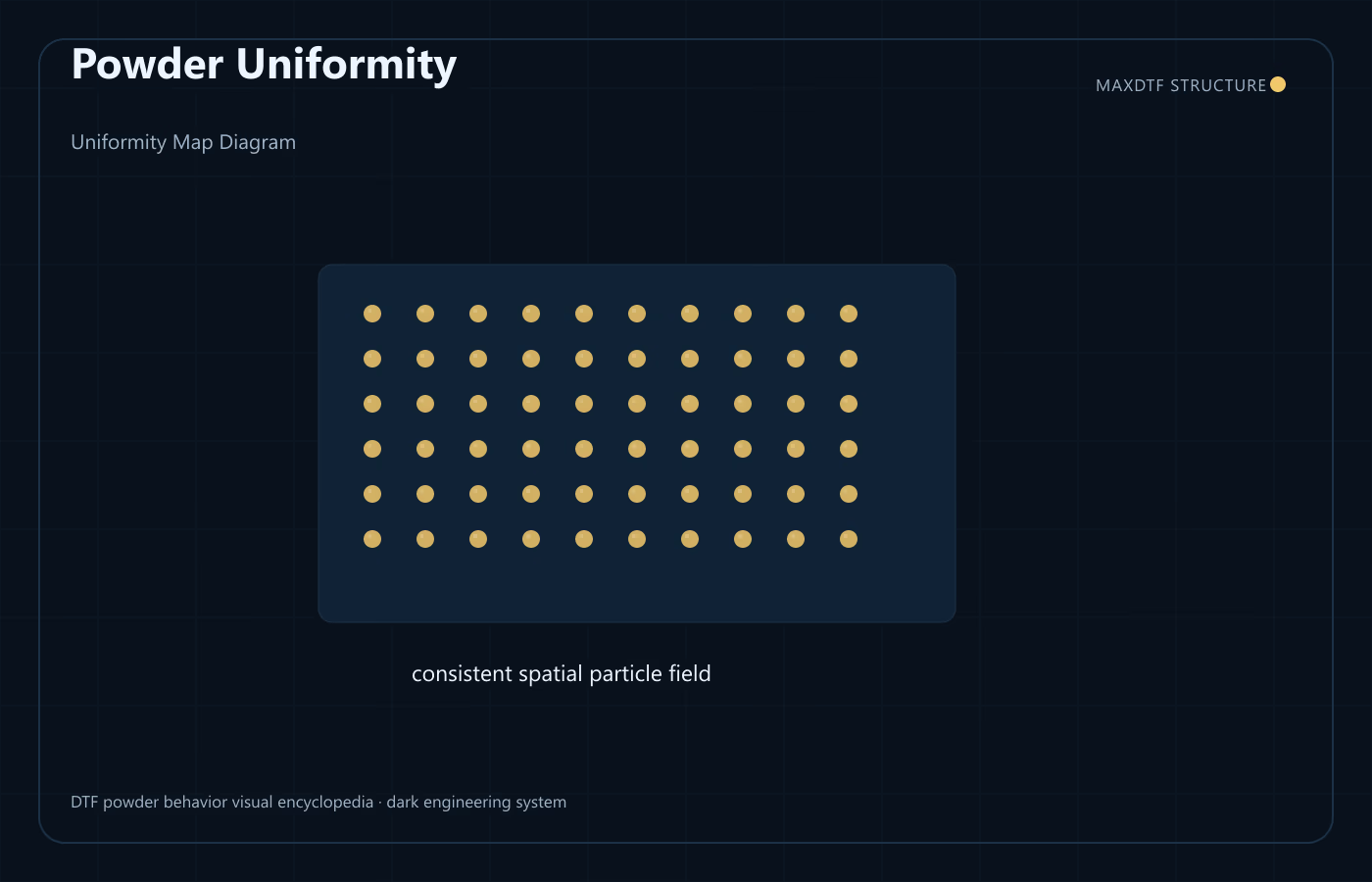
Powder uniformity refers to the consistency of powder particle distribution and attachment across a printed surface within the DTF printing system.
It defines whether particles are applied in a consistent manner across different regions, maintaining similar density and coverage characteristics.
Powder uniformity is not a measure of performance. It does not indicate bonding strength or print quality. It defines how consistently powder is positioned before transformation into a bonding layer.
It is closely related to Powder Distribution, which defines where particles are located, while uniformity defines how consistent that distribution is.
It also interacts with Powder Pickup, as variations in attachment directly affect overall uniformity.
How Powder Uniformity Functions in the DTF System
Within the DTF system, powder uniformity functions as a consistency control condition for particle behavior.
Particles may be distributed across the surface through Powder Distribution, but this distribution may vary across different regions. Uniformity defines whether these variations are minimized or amplified.
Uniformity is influenced by how particles move and settle. Powder Flowability determines whether particles can spread evenly, while Powder Particle Size influences how consistently particles can occupy a given area.
It is also affected by attachment behavior. Variations in Powder Pickup lead directly to variations in uniformity, as inconsistent attachment results in uneven particle coverage.
Environmental conditions further influence uniformity. Variables defined in Environmental Influence Architecture in DTF Printing may cause localized differences in particle behavior, affecting how consistently powder is applied.
Through these interactions, powder uniformity defines whether particle behavior remains stable across the entire surface.
Interaction Path
Powder uniformity emerges as a result of multiple interacting variables.
Particles are first positioned through Powder Distribution, which defines where particles are located.
Powder Pickup determines which particles remain attached to the surface.
Powder uniformity then defines whether this distribution and attachment remain consistent across different regions.
Environmental conditions described in Environmental Influence Architecture in DTF Printing influence how consistently these processes occur, introducing variability under certain conditions.
Through this sequence, powder uniformity defines the consistency of particle behavior across the system.
What Powder Uniformity Does NOT Do
Powder uniformity does not define how particles melt, fuse, or form a bonding structure. These behaviors belong to Adhesive Bonding Architecture in DTF Printing.
It does not determine final adhesion strength, durability, or transfer performance.
It does not define particle movement itself, which is described by Powder Flowability.
It does not define spatial placement, which is defined by Powder Distribution.
Powder uniformity is not a direct measure of quality but a condition of consistency.
Structural Nature
Powder uniformity exists as a consistency condition within the Powder Behavior layer.
It does not belong to material composition or structural layers. Instead, it defines how consistently particle behavior is maintained across the surface.
Its influence is expressed through whether particle distribution and attachment remain stable across different areas.
Powder uniformity interacts with Powder Distribution by evaluating spatial consistency, with Powder Pickup by reflecting attachment consistency, and with Powder Flowability by influencing how particles spread.
It does not define these variables individually but represents their combined consistency.
Performance Boundaries
Powder uniformity defines a balance between consistency and variability.
Highly uniform conditions result in consistent particle behavior across the system, reducing variability between regions.
Lower uniformity introduces differences in particle behavior, leading to localized variations.
This creates a range within which uniformity must be maintained to ensure stable system behavior.
Powder uniformity does not determine performance outcomes but defines how consistent system conditions are.
Common Misunderstandings
Powder uniformity is often confused with distribution. In reality, distribution defines where particles are located, while uniformity defines how consistent that placement is.
Another common misunderstanding is treating uniformity as a direct indicator of quality. Uniformity only describes consistency, not final performance.
It is also often assumed that uniformity is controlled by a single factor. In practice, it results from the interaction of Powder Distribution, Powder Pickup, and environmental conditions.
Uniformity is not an independent variable but a system-level outcome.
Where Powder Uniformity Sits in the System
Powder uniformity belongs to the Powder Behavior layer of the DTF system.
It defines the consistency stage of particle behavior, following distribution and attachment.
Within the system, it operates alongside Powder Distribution, Powder Pickup, and Powder Flowability, evaluating how consistently these processes occur.
Its effects propagate into later stages of the system, including bonding and separation processes described in System Interaction Architecture in DTF Printing.
Related Concepts
This concept is part of the Powder Behavior Architecture in DTF Printing system.
– Powder Flowability
– Powder Distribution
– Powder Pickup
– Powder Particle Size
– Powder Electrostatics
– Environmental Influence Architecture in DTF Printing
– Adhesive Bonding Architecture in DTF Printing
– Ink Behavior Architecture in DTF Printing
– Release Timing Architecture in DTF Printing