
Introduction
During DTF printing, film behavior is not only defined by how ink is deposited or how the image is transferred, but also by how the material behaves within the printing environment. Factors such as surface interaction, particle movement, and handling consistency are often observed during production.
These behaviors are not defined by surface-visible layers such as the ink receptive layer or the release layer. Instead, they are associated with underlying material properties related to electrical behavior.
Within the Structural Architecture of DTF Film, the anti-static layer is a dedicated functional layer designed to define how electrostatic conditions are controlled at the material level.
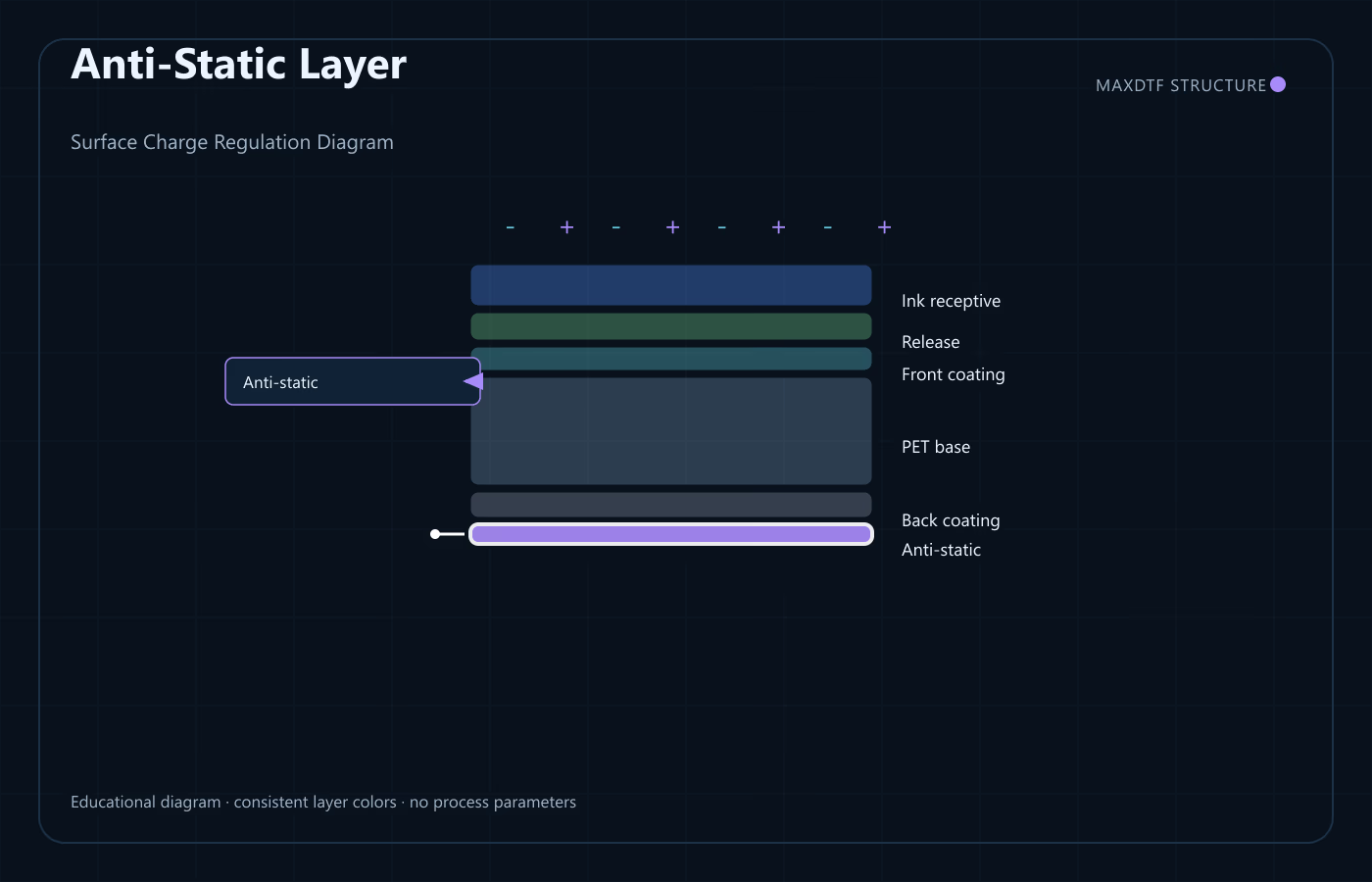
What Is Anti-Static Layer
Anti-static layer is a functional coating layer that defines the electrical charge behavior of the DTF film within the DTF system.
It is applied as part of the coating structure to regulate how static charge is generated, distributed, and dissipated across the film surface.
This layer does not participate in printing or transfer, but defines an underlying physical condition that influences how the material behaves during handling and processing.
How Anti-Static Layer Functions in the DTF System
Within the DTF system, the anti-static layer functions as a charge control layer.
Its role is to:
- Regulate surface charge accumulation on the film
- Enable controlled dissipation of electrostatic charge
- Maintain stable electrical conditions during printing
- Support consistent interaction with external materials such as DTF adhesive powder
The function of this layer is not visual or structural in the traditional sense.
It operates at the level of material physics, defining electrical behavior rather than surface interaction or mechanical bonding.
What Anti-Static Layer Does NOT Do
Anti-static layer does not control ink absorption.
Anti-static layer does not define release timing.
Anti-static layer does not influence color appearance.
Anti-static layer does not provide structural bonding between layers.
Anti-static layer does not replace the role of the back coating layer.
Anti-static layer does not function as a printing surface like the ink receptive layer.
Structural Nature
Anti-static layer belongs to the functional control system of the DTF film.
It may be integrated within the coating stack or applied as part of the overall coating design, depending on manufacturing structure.
Unlike structural layers such as the front coating layer, it does not serve as a bonding interface.
Unlike surface layers such as the ink receptive layer, it does not directly interact with ink.
Instead, it defines a material-level property that exists across the film surface.
Performance Boundaries
Anti-static layer operates within defined boundaries such as:
- Surface resistivity range
- Charge dissipation rate
- Coating uniformity
- Stability under environmental conditions
Outside these boundaries, the electrical behavior of the film may vary.
Anti-static layer does not control performance beyond its defined charge-regulation function.
Common Misunderstandings
Anti-static layer is often confused with the back coating layer.
It is sometimes assumed that backside coatings can perform the same function as anti-static layers.
Another common misunderstanding is that anti-static layers directly improve print quality.
In reality, this layer defines electrical conditions rather than visual output.
It is also incorrectly interpreted as an optional or secondary feature, rather than a defined component of system behavior.
Where Anti-Static Layer Sits in the System
Anti-static layer exists within the functional system of the DTF film.
A simplified structure includes:
- Ink receptive layer
- Release layer
- (Optional) front coating layer
- PET base film
Functional system overlay:
- Anti-Static Layer
Back side:
This configuration is part of the broader Structural Architecture of DTF Film.