
Introduction
In DTF printing, airflow is often misunderstood as a simple cooling or ventilation mechanism. In reality, airflow functions as a continuous environmental variable that shapes how thermal energy, moisture, and particles move within the system.
Airflow is not limited to fans or external ventilation systems. It exists as the movement of air across the printing environment, influencing how materials behave before, during, and after printing.
While airflow does not directly define material structure or system design, it plays a critical role in stabilizing or destabilizing environmental conditions. It determines how consistently temperature and moisture are distributed across the system.
Understanding airflow requires recognizing it as a dynamic transport mechanism rather than a passive background condition.
What Is Airflow
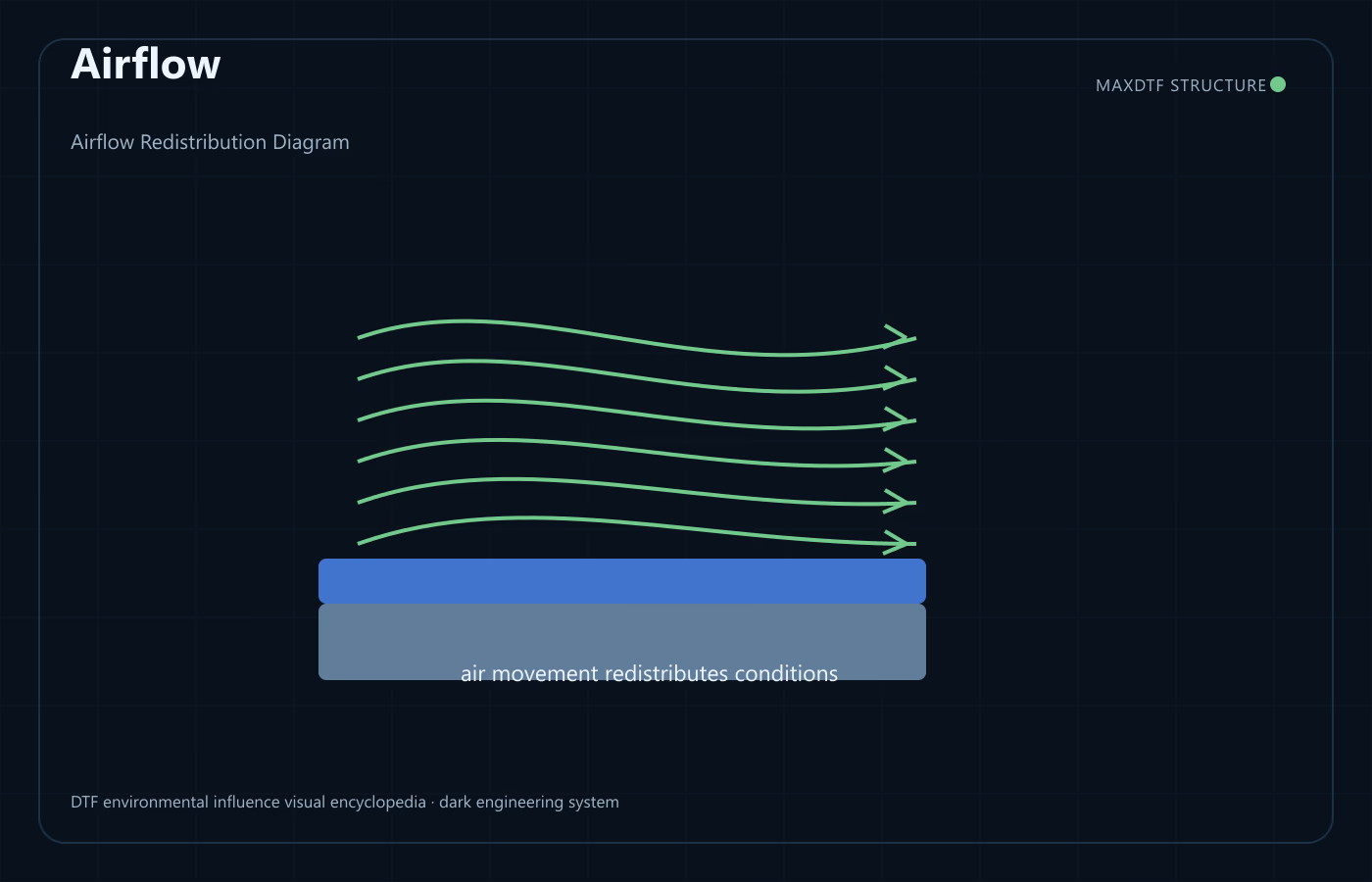
Airflow refers to the movement of air within the printing environment.
It defines how air circulates across surfaces such as film, ink layers, and adhesive powder, influencing how heat, moisture, and electrostatic conditions are distributed.
Airflow is not a material property and does not belong to any component within the DTF system. It exists as an environmental variable that shapes how other variables behave.
It is closely related to Airflow Stability, as consistent airflow patterns determine whether environmental conditions remain uniform or fluctuate across different areas of the system.
Airflow interacts directly with Temperature and Humidity, forming a combined environmental framework that defines how stable the printing environment is.
How Airflow Functions in the DTF System
Within the DTF system, airflow functions as a transport mechanism that redistributes heat, moisture, and charged particles.
Airflow affects how temperature is maintained across the system. By moving air, it influences how thermal energy spreads, connecting directly to Temperature and Ambient Thermal Stability.
It also affects how moisture behaves in the environment. Air movement determines how water vapor is distributed, linking airflow to Humidity, Moisture Absorption, and conditions such as Dew Point.
Airflow also influences electrostatic behavior. By moving air across surfaces, it can affect how charge accumulates or dissipates, interacting with Electrostatic Charge and Charge Dissipation.
In relation to material interaction, airflow indirectly influences how ink stabilizes, how adhesive powder behaves, and how surface conditions evolve, connecting to Ink Behavior Architecture in DTF Printing and Adhesive Bonding Architecture in DTF Printing.
Interaction Path
Airflow influences the system by continuously redistributing environmental conditions.
When airflow is stable, temperature and moisture are distributed evenly across the system. This leads to more consistent environmental conditions and more predictable material behavior.
When airflow is uneven or unstable, environmental conditions become localized. Some areas may experience higher temperature or moisture levels, while others remain relatively unchanged.
This uneven distribution affects how materials behave. Ink may respond differently across the surface, adhesive powder may interact inconsistently, and environmental conditions may shift dynamically.
Airflow also interacts with temperature and humidity to define transitional conditions. Through its influence on heat and moisture movement, it affects how conditions approach thresholds such as those defined by Dew Point, which may lead to Condensation Risk.
Through this mechanism, airflow does not directly control system behavior but defines how evenly environmental variables are distributed across the system.
What Airflow Does NOT Do
Airflow does not define material structure, including layers such as Release Layer, nor does it determine how these layers are constructed.
It does not define ink formulation or chemical behavior, which belong to Ink Behavior Architecture in DTF Printing.
It does not define adhesive composition or bonding mechanisms, which are described in Adhesive Bonding Architecture in DTF Printing.
Airflow does not define separation logic or release timing, which are part of Release Timing Architecture in DTF Printing.
It is not equivalent to cooling, and it does not independently determine system temperature.
Airflow does not define system performance outcomes and does not directly determine print quality or final transfer behavior.
Structural Nature
Airflow exists as a dynamic environmental variable outside the structural layers of the DTF system.
It does not belong to film, ink, or adhesive materials. Instead, it defines how environmental conditions move and evolve across the system.
Its influence is expressed through its ability to redistribute heat, moisture, and charge across surfaces.
Airflow interacts with Temperature by influencing how heat spreads, with Humidity by shaping moisture distribution, and with electrostatic conditions through its effect on charge movement.
It does not define these variables individually. It defines how they are spatially distributed and how stable they remain over time.
Performance Boundaries
Airflow defines distribution conditions but does not define performance outcomes.
It operates within a range where environmental distribution remains stable. Outside this range, it leads to uneven conditions across the system.
Airflow does not determine whether performance is acceptable. It defines how consistent environmental conditions are across different areas of the system.
Common Misunderstandings
Airflow is often treated as a cooling function. In reality, airflow does not create or remove heat but redistributes existing thermal energy across the system.
Another misunderstanding is that stronger airflow always improves system stability. Excessive or uneven airflow may lead to inconsistent environmental conditions across different areas.
Airflow is also often treated as independent from other variables. In practice, it interacts closely with Temperature and Humidity, forming a combined environmental system.
Where Airflow Sits in the System
Airflow belongs to the Environmental Influence layer of the DTF system.
It is not part of structural, material, or process layers. Instead, it defines how environmental conditions are distributed across all components.
Within the system, it operates alongside Temperature and Humidity, and its effects become visible through system-wide interactions described in System Interaction Architecture in DTF Printing.
Related Concepts
This concept is part of the Environmental Influence Architecture in DTF Printing system.
– Humidity
– Temperature
– Airflow
– Moisture Absorption
– Dew Point
– Condensation Risk
– Electrostatic Charge
– Charge Dissipation
– Adhesive Bonding Architecture in DTF Printing
– System Interaction Architecture in DTF Printing