
Introduction
In DTF printing, the visible outcome of a print—such as color density, edge clarity, and image completeness—is often attributed to ink performance. This perspective treats ink as the primary determinant of how an image appears on the film.
However, in the DTF system, ink does not directly interact with the base material. Instead, it is received and stabilized by a specifically engineered surface layer within the film structure. This layer defines how ink behaves before transfer occurs.
Understanding this layer requires moving away from a result-based interpretation and toward a structural definition of how surface behavior is controlled within the layered architecture of DTF film.
This concept is part of the Structural Architecture of DTF Film, which defines how layered film systems are constructed.
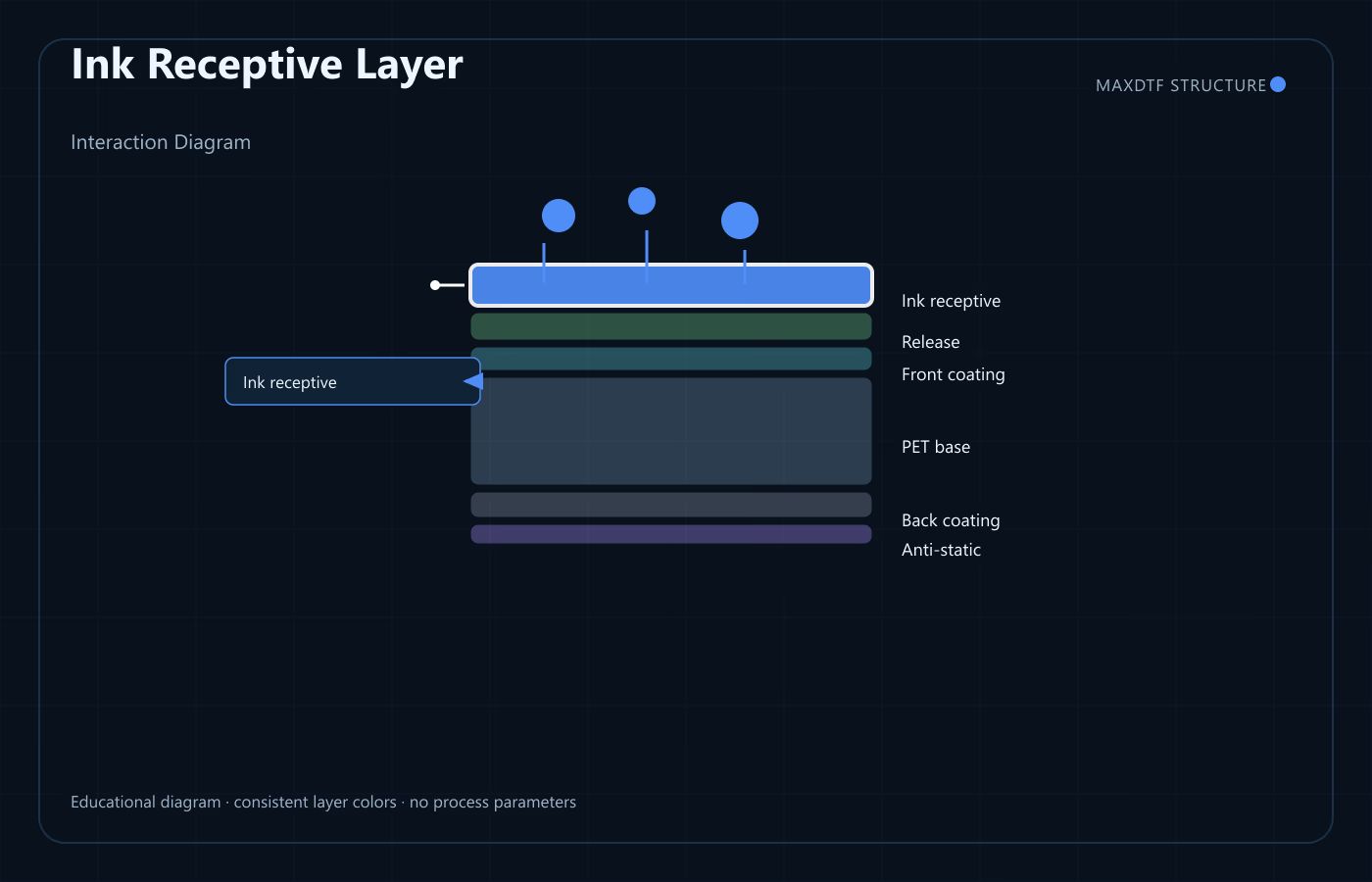
What Is Ink Receptive Layer
Ink receptive layer is a surface functional layer that defines how ink is received, distributed, and retained on the DTF film within the DTF system.
It is the outermost layer on the printable side of the film and serves as the direct interface between the deposited DTF ink and the film surface.
This layer establishes controlled surface energy conditions that allow ink to remain stable and positioned prior to interaction with DTF adhesive powder.
How Ink Receptive Layer Functions in the DTF System
Within the DTF system, the ink receptive layer functions as the primary interface for ink deposition.
Its role is to:
- Accept incoming ink droplets during printing
- Control the spread and positioning of ink on the surface
- Maintain ink stability before transfer
- Provide a consistent surface for image formation
It operates at the boundary between liquid ink and the solid film surface, sitting above the release layer in the coating structure.
The function of this layer is surface-level and directly related to how image information is formed and maintained prior to transfer.
What Ink Receptive Layer Does NOT Do
Ink receptive layer does not control release timing.
Ink receptive layer does not define separation behavior between film and transferred image.
Ink receptive layer does not regulate internal bonding between coating layers.
Ink receptive layer does not control film transport behavior or mechanical handling.
Ink receptive layer does not function as a structural bonding interface like front coating layer.
Ink receptive layer does not replace the role of back coating layer.
Structural Nature
Ink receptive layer belongs to the front-side functional surface system of the DTF film.
It is positioned above the release layer and forms the outermost coating layer exposed during printing.
Unlike internal layers such as the front coating layer, which exist within the structural stack, the ink receptive layer directly interacts with external materials during the printing process.
Its structure is designed to maintain controlled surface behavior rather than to provide internal mechanical bonding.
Performance Boundaries
Ink receptive layer operates within defined boundaries such as:
- Surface energy range
- Ink compatibility window
- Coating thickness uniformity
- Stability during drying and handling
Outside these boundaries, the behavior of ink on the surface may vary.
Ink receptive layer does not control performance outside its defined surface function.
Common Misunderstandings
Ink receptive layer is often assumed to be equivalent to the ink itself.
It is also commonly interpreted as the sole determinant of print quality.
Another misunderstanding is that increasing ink interaction with the surface always improves performance.
In reality, the ink receptive layer defines controlled ink behavior rather than maximizing absorption.
It is also frequently confused with structural layers, despite serving a different function within the system.
Where Ink Receptive Layer Sits in the System
Ink receptive layer sits at the top of the front-side coating structure of DTF film.
A simplified structure includes:
On the reverse side:
It is the outermost functional layer that directly interfaces with ink during printing.