
Introduction
In DTF printing, the release layer does not exist merely as a coating applied onto the film surface. It exists as a defined structural interface that determines where separation between materials can occur within the system.
While concepts such as Release Surface Energy define the energetic condition of the interface, they do not define whether a separation boundary structurally exists.
This boundary is defined as the Release Layer Definition.
Release Layer Definition is often misunderstood as a functional coating that improves peel performance. However, such interpretations refer to performance outcomes rather than the definition of the concept.
Within the DTF system, Release Layer Definition must be understood as a structural interface condition that defines the existence of a separation boundary between the printed material and the film, independent of peel strength or process parameters.
Understanding this concept requires separating structural definition from both interfacial energy and separation behavior.
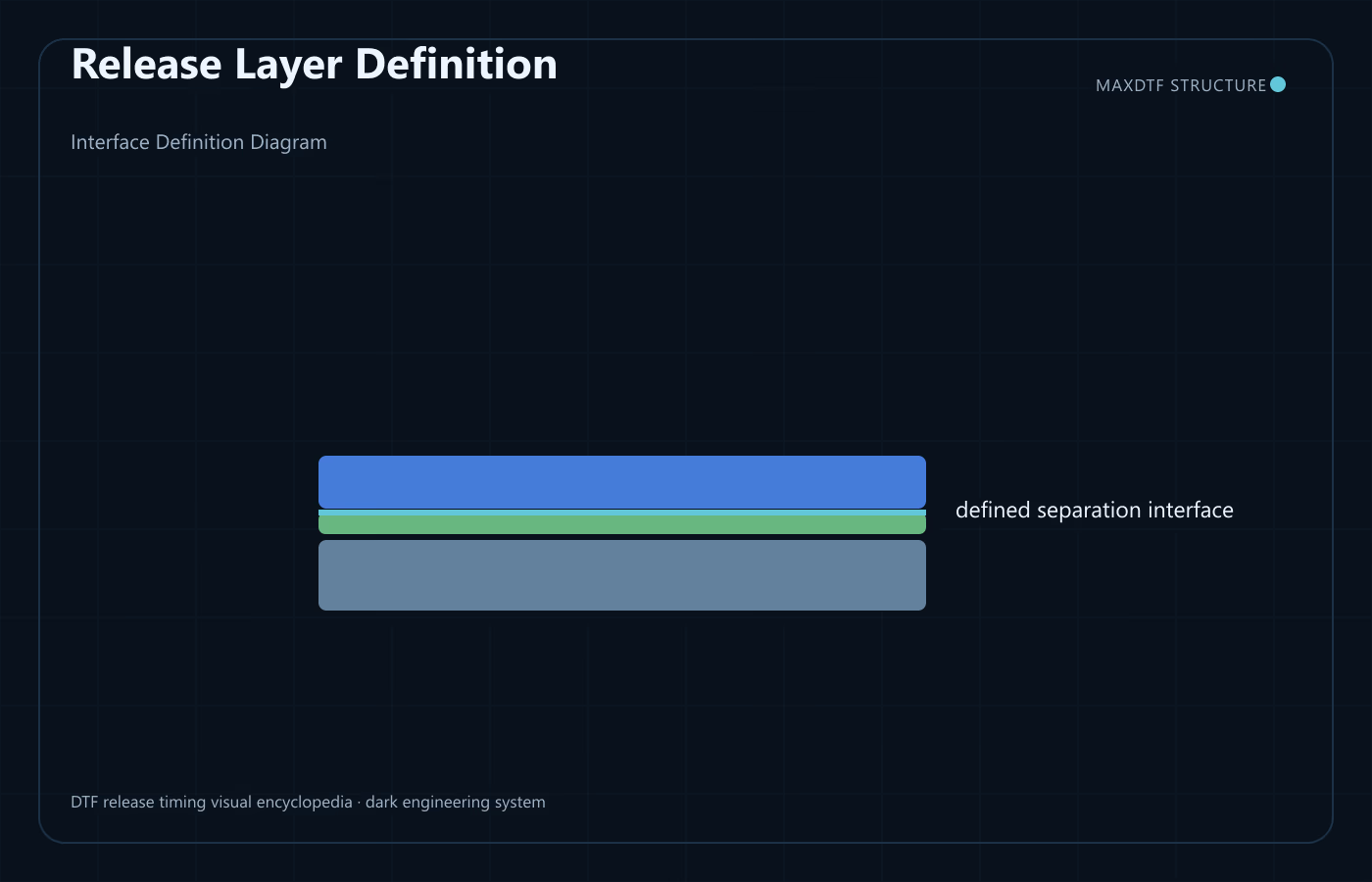
What Is Release Layer Definition
Release Layer Definition is the structural condition that defines the existence of a separation interface between the printed ink–adhesive composite and the PET substrate on DTF Film.
It describes the presence of a defined boundary within the system where separation is allowed to occur.
This concept does not describe how separation happens or how easily it occurs.
Instead, it defines whether the system contains a valid separation interface.
How Release Layer Definition Functions in the DTF System
Within the system, Release Layer Definition defines whether a structural boundary exists between:
– the PET substrate
– the printed ink–adhesive composite layer
It describes the existence of a separation interface, rather than its strength, stability, or activation condition.
Release Layer Definition operates alongside interfacial and system-level conditions such as:
– Release Surface Energy
– Release Activation State
– Release Readiness State
– Release Force Profil
It also relates to higher-level separation outcomes such as:
– Release Uniformity
– Release Stability
– Release Completeness
Release Layer Definition defines whether a separation boundary exists, not how separation behaves or how complete the separation will be.
What Release Layer Definition Does NOT Do
Release Layer Definition does not define the surface energy condition of the interface (see Release Surface Energy).
Release Layer Definition does not define when separation occurs (see Release Activation State).
Release Layer Definition does not define whether the system is ready for separation (see Release Readiness State).
Release Layer Definition does not define force distribution during separation (see Release Force Profil).
Release Layer Definition does not define whether separation is uniform across the surface (see Release Uniformity).
Release Layer Definition does not define whether separation remains stable under different conditions (see Release Stability).
Release Layer Definition does not define the type of separation state (see Peel Mode).
Release Layer Definition does not define whether separation is complete or partial (see Release Completeness, Partial Release Condition, Over-Release Condition).
Release Layer Definition does not define system failure conditions (see Release Failure Boundary).
Release Layer Definition does not define process parameters such as temperature, pressure, or timing.
Release Layer Definition does not independently define system performance or final transfer outcomes.
Structural Nature
Release Layer Definition is a structural interface condition within the DTF system.
It defines the existence of a separation boundary but does not describe:
– the strength of that boundary
– the energy characteristics of that boundary
– the behavior of separation at that boundary
This concept is not a dimensional parameter and does not define thickness.
It is also not a process parameter.
Release Layer Definition exists as a system-level interface definition that enables separation to be structurally possible.
Performance Boundaries
Release Layer Definition operates within structural boundary conditions.
Within these boundaries, a defined separation interface exists between the film and the printed material.
Outside these boundaries, the system may no longer contain a valid separation interface, and separation behavior cannot be defined in system terms.
These boundaries do not represent peel performance or durability.
They define only whether the concept of separation remains structurally valid within the system.
Common Misunderstandings
Release Layer Definition is often interpreted as a coating designed to improve peel performance.
In reality, it defines the existence of a separation interface, not the effectiveness of peeling.
It is also commonly confused with Release Surface Energy.
Release Surface Energy defines how the interface behaves energetically, while Release Layer Definition defines whether the interface exists structurally.
Another misunderstanding is that modifying the release layer directly determines separation quality.
Within the DTF system, the release layer defines the boundary, while separation behavior is governed by system conditions such as Release Force Profil, Release Uniformity, and Release Stability.
Where Release Layer Definition Sits in the System
Release Layer Definition exists at the interface between the PET substrate and the coating system on DTF Film.
It belongs to the Interface Foundation Layer within the Release Timing Architecture in DTF Printing.
Within the system, it defines the structural boundary upon which all separation-related behaviors are built, including:
– activation conditions ( Release Activation State )
– separation behavior ( Release Force Profil )
– separation classification ( Peel Mode )
– separation completeness ( Release Completeness )
This concept is part of the Release Timing Architecture in DTF Printing system.