
Introduction
In DTF printing, powder is expected to be distributed and attached across the printed surface in a continuous and consistent manner. However, under certain conditions, areas may exist where powder is insufficient or completely absent.
Powder voids are often interpreted as defects, such as missing powder or weak coverage. In reality, they are a system-level condition that defines how particle distribution and attachment become incomplete.
They do not define bonding strength or final performance directly. Instead, they define where particle coverage is insufficient before thermal activation.
Understanding powder voids requires recognizing them as a condition of insufficient particle presence within the powder behavior system.
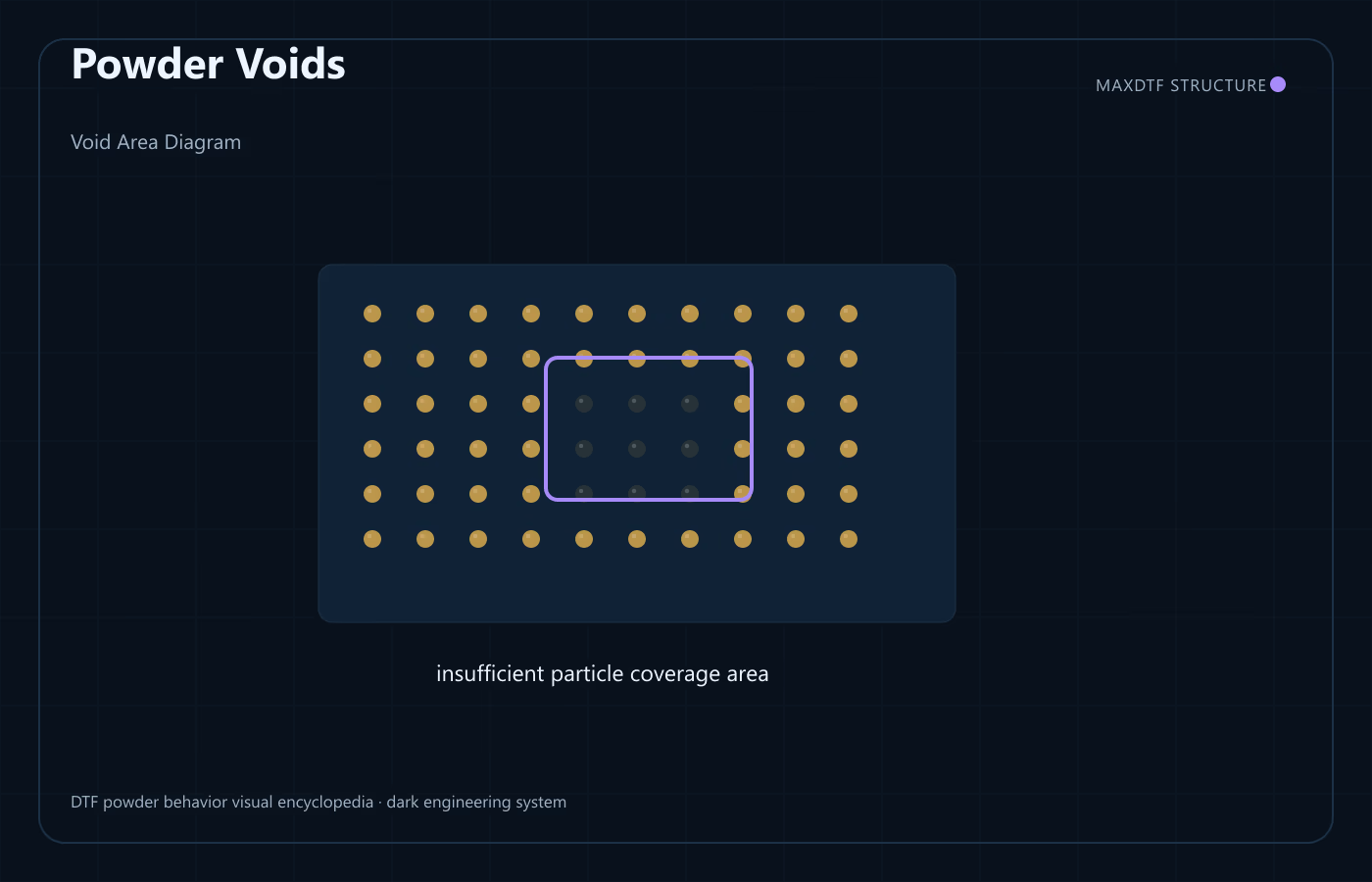
What Is Powder Voids
Powder voids refer to areas where powder particles are insufficiently present or completely absent within the DTF printing system.
They define a condition in which particle coverage falls below the expected level for a given surface area.
Powder voids are not a performance metric. They do not directly describe bonding behavior or print quality. They define how particle distribution becomes incomplete.
They are closely related to Powder Distribution, as voids represent gaps in spatial positioning.
They also interact with Powder Pickup, since failure of particles to attach contributes directly to missing coverage.
How Powder Voids Functions in the DTF System
Within the DTF system, powder voids function as an insufficiency condition in particle coverage.
Particles are first distributed across the surface through Powder Distribution and attached through Powder Pickup. When this process becomes incomplete, voids appear.
This directly affects coverage continuity, resulting in localized areas with insufficient particle presence.
Voids are influenced by particle movement and interaction. Powder Flowability affects whether particles can reach all areas, while Powder Particle Size influences how effectively particles can occupy small or complex regions.
They are also influenced by attachment behavior. Variations in Powder Pickup may prevent particles from attaching to certain areas, creating gaps.
Environmental conditions further affect void formation. Variables defined in Environmental Influence Architecture in DTF Printing, such as airflow and humidity, influence how particles move and whether they remain in place.
Electrostatic conditions also contribute. Under certain conditions defined in Powder Electrostatics, particles may be repelled from specific regions, increasing the likelihood of voids.
Through these interactions, powder voids define how particle coverage becomes incomplete within the system.
Interaction Path
Powder voids emerge from the interaction of multiple powder behavior variables.
Particles are initially positioned through Powder Distribution, defining where particles are located.
Powder Pickup determines whether these particles attach to the surface.
When movement or attachment is insufficient, gaps appear, resulting in voids.
Environmental conditions described in Environmental Influence Architecture in DTF Printing influence whether particles can reach and remain in all regions.
Through this sequence, powder voids represent a shift from complete coverage to insufficient particle presence.
What Powder Voids Does NOT Do
Powder voids do not define how particles melt, fuse, or form a bonding structure. These behaviors belong to Adhesive Bonding Architecture in DTF Printing.
They do not determine final adhesion strength, durability, or transfer performance directly.
They do not define particle movement itself, which is described by Powder Flowability.
They do not define release or separation behavior, which are part of Release Timing Architecture in DTF Printing.
Powder voids are not a defect category but a condition of insufficient coverage.
Structural Nature
Powder voids exist as a coverage insufficiency condition within the Powder Behavior layer.
They do not belong to material composition or structural layers. Instead, they define where particle presence is lacking.
Their influence is expressed through gaps in particle coverage across the surface.
Powder voids interact with Powder Distribution by reflecting missing spatial positioning, with Powder Pickup by indicating failed attachment, and with Powder Flowability by showing limitations in particle movement.
They do not define these variables individually but represent a deviation in their combined behavior.
Performance Boundaries
Powder voids define a balance between complete coverage and insufficient particle presence.
Controlled conditions allow particles to cover the surface adequately, minimizing void formation.
Under unstable conditions, voids increase, leading to incomplete coverage.
This creates a range within which particle coverage must remain sufficient to maintain stable system behavior.
Powder voids do not determine performance outcomes but define whether particle presence is complete.
Common Misunderstandings
Powder voids are often interpreted as a direct result of insufficient powder application. In reality, they result from interaction between distribution, pickup, and environmental variables.
Another common misunderstanding is treating voids as purely local defects. In practice, they are part of a broader system condition affecting particle coverage.
It is also often assumed that voids only affect visual appearance. In reality, they reflect underlying particle behavior and influence subsequent system processes.
Powder voids are not an isolated issue but part of a broader interaction system.
Where Powder Voids Sits in the System
Powder voids belong to the Powder Behavior layer of the DTF system.
They define the insufficiency stage where particle coverage falls below controlled distribution.
Within the system, they operate alongside Powder Distribution, Powder Pickup and Powder Flowability, reflecting how particles fail to occupy certain regions.
Their effects propagate into later stages of the system, including bonding and separation processes described in System Interaction Architecture in DTF Printing.
Related Concepts
This concept is part of the Powder Behavior Architecture in DTF Printing system.
– Powder Flowability
– Powder Distribution
– Powder Pickup
– Powder Particle Size
– Powder Electrostatics
– Environmental Influence Architecture in DTF Printing
– Adhesive Bonding Architecture in DTF Printing
– Ink Behavior Architecture in DTF Printing
– Release Timing Architecture in DTF Printing