
Introduction
In DTF printing, surface resistivity is often mentioned in discussions about static control, but it is frequently misunderstood as a direct measure of electrostatic problems.
In reality, surface resistivity does not describe how much electrostatic charge exists. Instead, it defines how that charge behaves once it is present on a material surface.
Surface resistivity is a critical variable that determines whether electrostatic charge remains localized, spreads across a surface, or dissipates over time.
Understanding surface resistivity requires separating it from the concept of Electrostatic Charge. While electrostatic charge describes the presence of charge, surface resistivity defines the mobility of that charge.
What Is Surface Resistivity
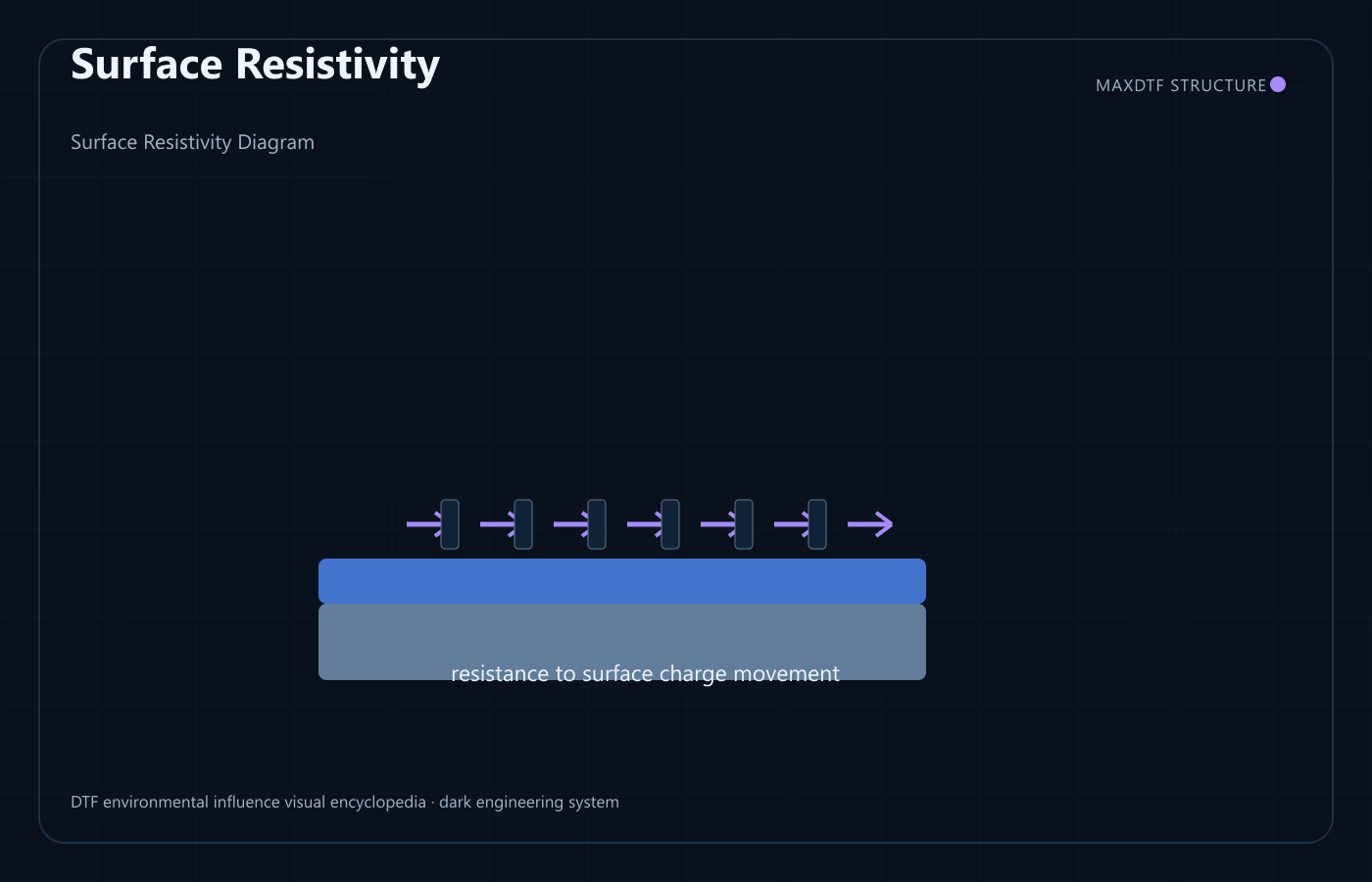
Surface resistivity refers to the resistance of a material surface to the flow of electrical charge.
It defines how easily charge can move across the surface of materials such as DTF film, ink layers, or coated structures.
Surface resistivity is not a structural layer or a visible property. It is a physical characteristic that emerges from material composition and surface treatment.
It is closely related to Charge Dissipation, as the ability of charge to move across a surface directly affects how it can be released or neutralized.
Surface resistivity is also influenced by environmental variables such as Humidity and Temperature, which affect how conductive or resistive a surface behaves.
How Surface Resistivity Functions in the DTF System
Within the DTF system, surface resistivity functions as a control mechanism for charge mobility.
When electrostatic charge is generated, its behavior depends on how easily it can move across the material surface. This is determined by surface resistivity.
Low surface resistivity allows charge to spread or dissipate more easily, reducing localized charge buildup. High surface resistivity causes charge to remain concentrated in specific areas.
This directly affects how particles behave on the surface. Adhesive powder interaction is influenced by charge distribution, linking surface resistivity to Adhesive Bonding Architecture in DTF Printing.
Surface resistivity also affects how charge interacts with environmental conditions. It determines how responsive the system is to changes in Humidity and Airflow, which influence charge movement and redistribution.
Through this mechanism, surface resistivity does not create charge but defines how charge behaves once it exists.
Interaction Path
Surface resistivity influences the system by controlling how electrostatic charge moves across surfaces.
When surface resistivity is low, charge can move more freely. This allows charge to spread across a larger area or dissipate over time, leading to more uniform electrostatic conditions.
When surface resistivity is high, charge becomes localized. It remains concentrated in specific areas, creating uneven electrostatic fields.
These localized fields influence particle behavior. Adhesive powder may accumulate unevenly, and interactions across the surface may become inconsistent.
Surface resistivity interacts closely with Electrostatic Charge, determining how charge behaves after it is generated.
It also interacts with Charge Dissipation, defining how quickly or slowly charge can be released from the system.
Environmental conditions further influence this interaction. Through Humidity, surface conductivity may change, altering resistivity. Through Airflow, charge redistribution patterns may shift.
Through this mechanism, surface resistivity defines the mobility and distribution of electrostatic conditions within the system.
What Surface Resistivity Does NOT Do
Surface resistivity does not define how much electrostatic charge is generated, which is determined by Electrostatic Charge.
It does not define material structure, including layers such as Release Layer, nor does it determine how these layers are constructed.
It does not define ink formulation or chemical behavior, which belong to Ink Behavior Architecture in DTF Printing.
It does not define adhesive composition or bonding mechanisms, which are described in Adhesive Bonding Architecture in DTF Printing.
Surface resistivity does not define release timing or separation behavior, which are part of Release Timing Architecture in DTF Printing.
It does not independently determine system performance or print quality.
Structural Nature
Surface resistivity exists as a material-level physical characteristic that affects how electrical charge behaves on a surface.
It is not a standalone layer but emerges from the composition and structure of surface coatings and materials.
Its behavior depends on both material properties and environmental conditions. It interacts with Electrostatic Charge to define charge behavior and with Charge Dissipation to define how charge is released.
Surface resistivity is also influenced by environmental variables such a Humidity and Temperature, which affect surface conductivity.
It does not act independently. It exists as part of a system of interactions that define electrostatic behavior.
Performance Boundaries
Surface resistivity defines how charge behaves but does not define performance outcomes.
It operates within a range where charge mobility remains stable. Outside this range, charge distribution may become uneven or unpredictable.
Surface resistivity does not determine whether system performance is acceptable. It defines the electrostatic conditions under which performance is observed.
Common Misunderstandings
Surface resistivity is often treated as a measure of static problems. In reality, it does not indicate whether static exists, only how it behaves.
Another misunderstanding is that lower resistivity is always better. While lower resistivity allows charge to move more easily, it may also change how charge interacts with the system.
Surface resistivity is also often assumed to be constant. In practice, it varies with environmental conditions such as Humidity and Temperature.
It is also commonly confused with electrostatic charge itself, even though the two describe different aspects of electrostatic behavior.
Where Surface Resistivity Sits in the System
Surface resistivity belongs to the Environmental Influence layer of the DTF system, while also interacting closely with material-level characteristics.
It is not a structural layer but a physical property that affects how surfaces behave under electrostatic conditions.
Within the system, it connects Electrostatic Charge and Charge Dissipation, and its effects become visible through interactions described in System Interaction Architecture in DTF Printing.
Related Concepts
This concept is part of the Environmental Influence Architecture in DTF Printing system.
– Electrostatic Charge
– Charge Dissipation
– Humidity
– Temperature
– Airflow
– Adhesive Bonding Architecture in DTF Printing
– System Interaction Architecture in DTF Printing