Introduction
In the structural design of DTF film, material behavior is not only defined by layers but also by intrinsic properties that determine how the film responds to mechanical forces during printing. Among these properties, film stiffness defines how the film maintains its form under tension, transport, and handling conditions.
Film stiffness is not a visible layer within the Structural Architecture of DTF Film, but it is a fundamental attribute that defines how the film behaves as a physical medium. It exists alongside structural components such as Base PET Film and structural variables such as PET Thickness.
Understanding film stiffness as a defined property helps separate structural design from mechanical response, allowing DTF film to be interpreted as both a layered system and a physical material.
What Is Film Stiffness
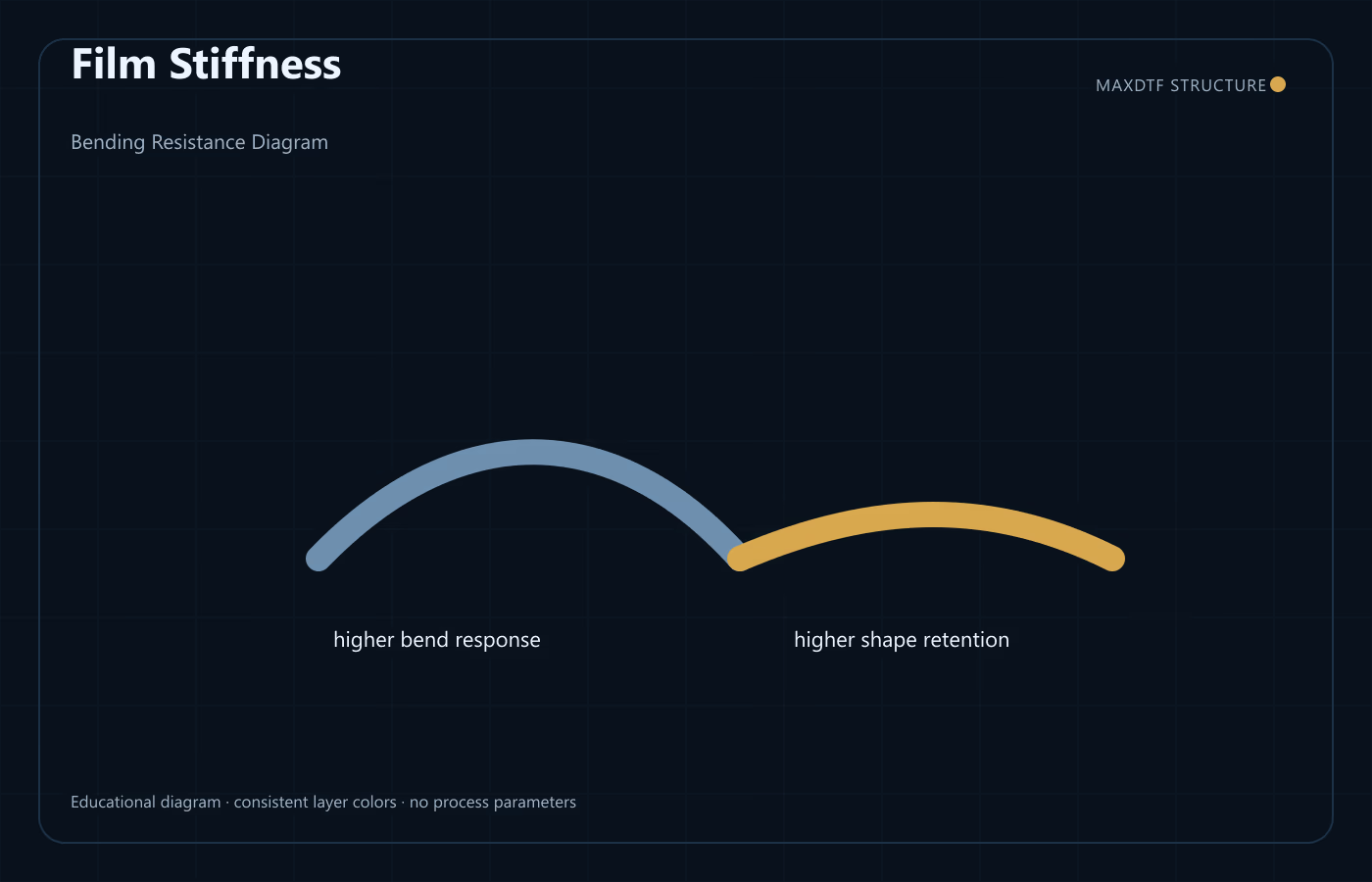
Film stiffness is a material property that defines the resistance of DTF film to bending and deformation within the DTF printing system.
It describes how strongly the film maintains its shape when subjected to external forces such as tension, curvature, or directional movement. This property exists independently of functional layers such as Ink Receptive Layer and Release Layer, and belongs to the mechanical profile of the film as a material structure.
As a node-level concept, film stiffness defines a measurable property of the film rather than a coating layer, structural interface, or manufacturing process.
How Film Stiffness Functions in the DTF System
Within the DTF system, the ink receptive layer functions as the primary interface for ink Within the DTF system, film stiffness functions as a mechanical stability parameter.
Its role is to:
- define how the film maintains shape during transport
- define resistance to bending during handling
- define how the film behaves under directional movement
- define a mechanical boundary within the overall DTF Film structure
Film stiffness operates alongside the Base PET Film and the broader Layer Stack Structure in DTF Film, but it does not function as a layer itself.
It is part of the film’s physical behavior during movement through the system and remains distinct from surface-related functions defined by the Ink Receptive Layer or backside mechanical functions associated with the Back Coating Layer.
What Film Stiffness Does NOT Do
Film stiffness does not control ink absorption.
Film stiffness does not define release behavior.
Film stiffness does not determine powder adhesion.
Film stiffness does not regulate electrostatic behavior.
Film stiffness does not replace the function of Release Layer, Ink Receptive Layer, Anti-Static Layer, or Back Coating Layer.
It defines mechanical resistance only, not surface interaction, bonding, or separation.
Structural Nature
Film stiffness belongs to the property layer of the DTF film system.
It is associated with the mechanical character of the Base PET Film and the overall dimensional behavior of the film. Unlike Front Coating Layer, Release Layer, or Ink Receptive Layer, film stiffness is not a coating component and cannot be visually identified as an individual layer.
It exists as a property of the material system rather than as a separate structural element.
Within the Structural Architecture of DTF Film, film stiffness should therefore be interpreted as a node-level attribute connected to the base material, not as an independent layer within the coating stack.
Performance Boundaries
Film stiffness operates within defined boundaries such as resistance to bending, deformation tolerance, and shape retention under mechanical stress.
It defines how the film maintains dimensional stability during movement, but does not extend beyond mechanical response.
Film stiffness does not control surface behavior, transfer separation, or bonding conditions. These functions are defined elsewhere within the film system by components such as Release Layer, Ink Receptive Layer, and DTF Adhesive Powder.
As a material property, it remains limited to defining the film’s resistance to physical deformation.
Common Misunderstandings
Film stiffness is often misunderstood as a direct indicator of overall film quality.
It is also sometimes assumed that higher stiffness automatically results in better printing performance. In reality, film stiffness defines mechanical resistance, not printing effectiveness.
Another common misunderstanding is that stiffness can replace structural design. However, film stiffness does not substitute for the roles of Base PET Film, Front Coating Layer, or Back Coating Layer.
It is also frequently confused with PET Thickness. Although both are material properties associated with the base film, they are not identical concepts and should not be used interchangeably.
Where Film Stiffness Sits in the System
Film stiffness sits at the node level within the Structural Architecture of DTF Film.
It is associated with the Base PET Film and exists as a mechanical property of the overall DTF Film system.
Within the hierarchy of the film structure:
- DTF Film defines the complete material system
- Base PET Film defines the foundational substrate
- film stiffness defines a mechanical property of that substrate
This places film stiffness alongside other node-level concepts such as PET Thickness rather than alongside layer-level concepts such as Release Layer.