
Introduction
In DTF film specifications, thickness is one of the most frequently referenced parameters. It is commonly expressed in microns and is often used to distinguish between different film types.
However, thickness is often interpreted as a simple measure of material size, without considering its role within the film system. This interpretation treats thickness as a standalone specification rather than as part of a structured material definition.
Within the Structural Architecture of DTF Film, thickness is not a layer or a function, but a property that defines how the base material behaves as part of the overall system.
What Is PET Thickness
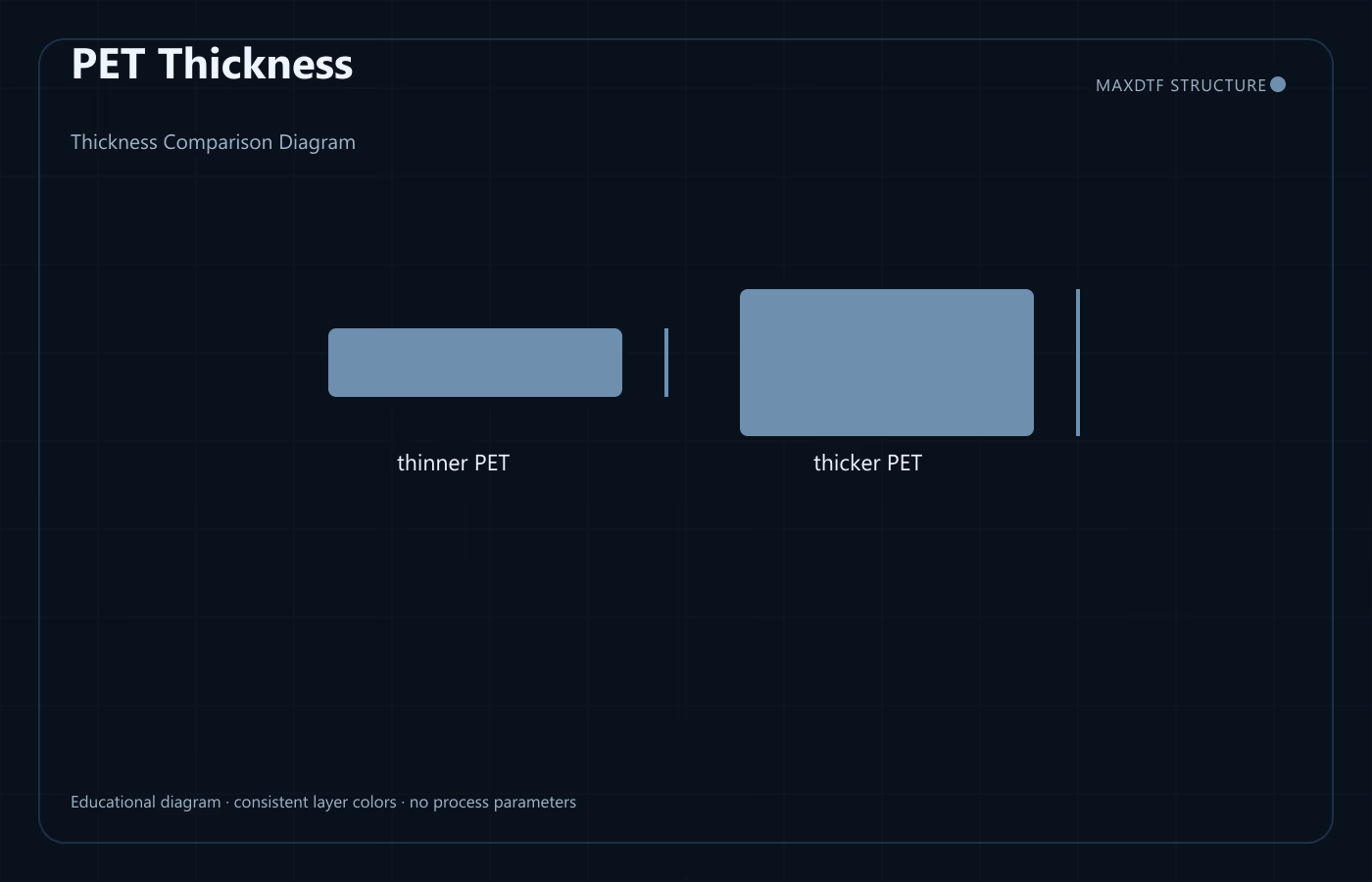
PET thickness is a material property that defines the physical thickness of the PET base film within the DTF film.
It is measured as the distance between the two surfaces of the PET substrate and is typically expressed in microns (µm).
This property defines the dimensional characteristic of the base material rather than the function of any coating layer.
How PET Thickness Functions in the DTF System
Within the DTF system, PET thickness functions as a structural property of the base material.
Its role is to:
- Define the dimensional profile of the PET base film
- Establish the physical scale of the film substrate
- Contribute to the overall material structure of the DTF film
- Serve as a baseline parameter within the layered construction
It operates as a property of the base material rather than as a functional layer such as the ink receptive layer or release layer.
What PET Thickness Does NOT Do
PET thickness does not control ink absorption.
PET thickness does not define release behavior.
PET thickness does not regulate powder adhesion.
PET thickness does not determine electrical charge behavior.
PET thickness does not replace structural or functional layers such as the front coating layer or the anti-static layer.
It is a dimensional property rather than a functional component.
Structural Nature
PET thickness belongs to the material property layer of the DTF film.
It is associated with the PET base film and defines a measurable attribute of that material.
Unlike coating layers or structural configurations, it does not exist as a separate component within the layer stack.
Instead, it defines a characteristic of the base substrate.
Performance Boundaries
PET thickness operates within defined boundaries such as:
- Thickness tolerance range
- Uniformity across the film
- Compatibility with coating processes
- Stability under thermal conditions
Outside these boundaries, the physical consistency of the material may vary.
PET thickness does not control performance beyond its role as a dimensional property.
Common Misunderstandings
PET thickness is often interpreted as a direct indicator of overall performance.
It is sometimes assumed that thickness alone defines material quality.
Another misunderstanding is that thickness replaces the role of structural design.
In reality, thickness defines a physical dimension rather than system behavior.
It is also frequently treated as interchangeable across different film constructions, despite being part of a broader material definition.
Where PET Thickness Sits in the System
PET thickness is a property of the PET base film.
It exists within the base layer of the DTF film.
It does not sit as a layer in the coating stack.
Instead, it defines a characteristic of the base material within the Structural Architecture of DTF Film.