
Introduction
In DTF printing, separation behavior can vary across a wide range of system conditions.
Within this range, outcomes such as complete separation, partial separation, or over-separation can be defined and described within the system framework.
However, there exists a limit beyond which separation behavior can no longer be described using the system’s internal concepts.
This limit is defined as the Release Failure Boundary.
Release Failure Boundary describes the point at which the separation system no longer operates within a definable or interpretable framework.
It is often misunderstood as a specific failure case or defect type. However, it does not describe a particular outcome.
Instead, it defines the boundary beyond which system behavior cannot be meaningfully categorized using existing concepts.
Understanding this concept requires distinguishing between abnormal outcomes and system breakdown.
What Is Release Failure Boundary
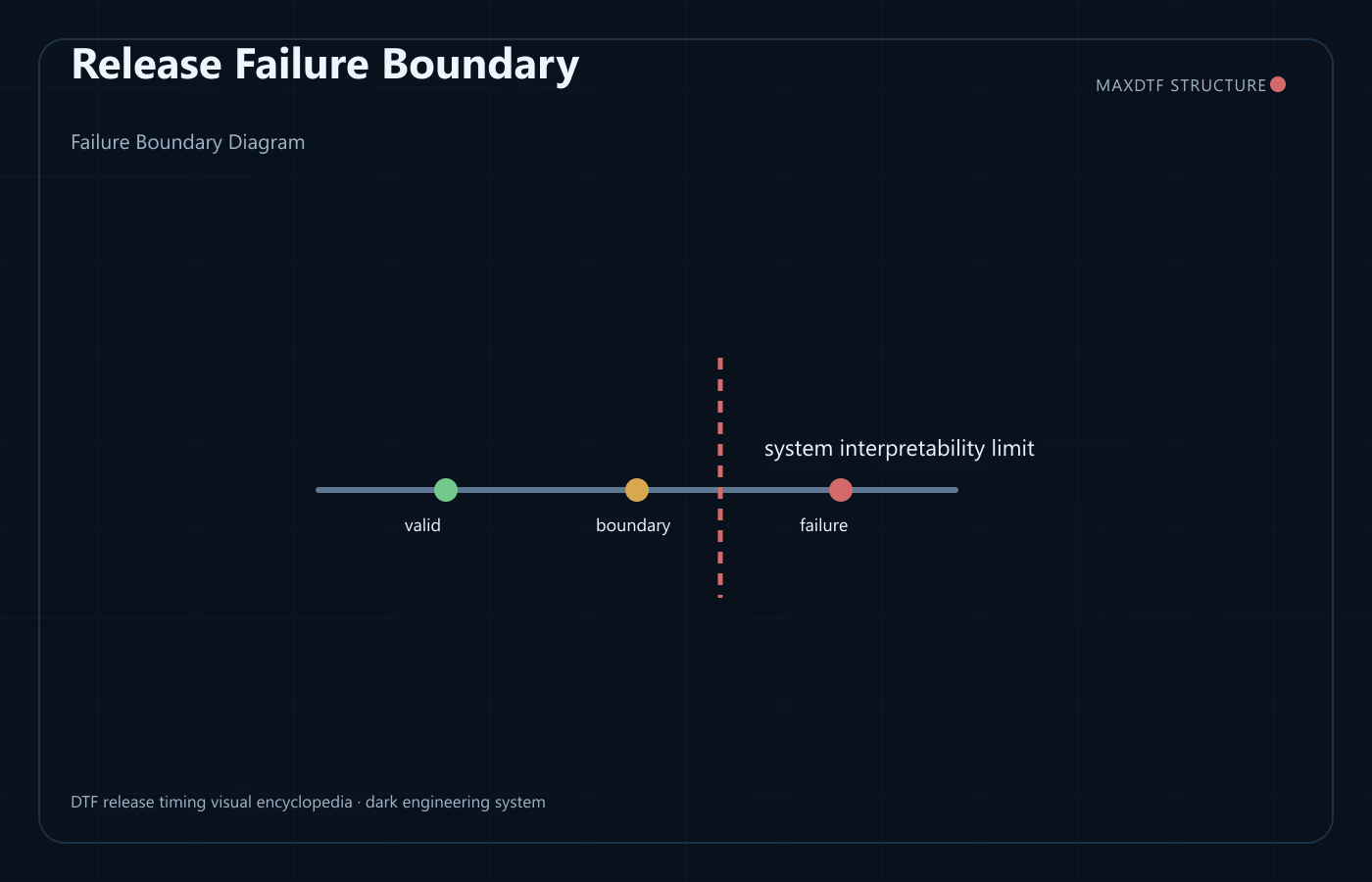
Release Failure Boundary is the system threshold beyond which separation behavior can no longer be defined within the Release Timing Architecture.
It describes the condition where the system loses its ability to produce interpretable separation outcomes.
This concept does not define a specific failure mode.
Instead, it defines the boundary at which the system exits the valid range of operation.
How Release Failure Boundary Functions in the DTF System
Within the DTF system, Release Failure Boundary represents the outer limit of valid separation behavior.
Inside this boundary:
– separation behavior can be defined and categorized
– outcomes can be described using concepts such as Release Completeness, Partial Release Condition, and Over-Release Condition
Beyond this boundary:
– separation behavior becomes undefined
– system outcomes cannot be categorized
– structural relationships between concepts break down
Release Failure Boundary operates beyond all system layers, including:
– Release Layer Definition
– Release Surface Energy
– Release Activation State
– Release Readiness State
– Release Force Profil
– Release Uniformity
– Release Stability
– Release Completeness
It defines the limit of the system’s interpretability, not the behavior within it.
What Release Failure Boundary Does NOT Do
Release Failure Boundary does not define whether a separation interface exists (see Release Layer Definition).
Release Failure Boundary does not define interfacial energy conditions (see Release Surface Energy).
Release Failure Boundary does not define when separation becomes possible (see Release Activation State).
Release Failure Boundary does not define whether the system is ready for separation (see Release Readiness State).
Release Failure Boundary does not define force distribution during separation (see Release Force Profil).
Release Failure Boundary does not define whether separation is uniform (see Release Uniformity).
Release Failure Boundary does not define whether separation remains stable (see Release Stability).
Release Failure Boundary does not define whether separation is complete or partial (see Release Completeness, Partial Release Condition, Over-Release Condition).
Release Failure Boundary does not define classification of separation behavior (see Peel Mode).
Release Failure Boundary does not define process parameters such as temperature, pressure, or speed.
Release Failure Boundary does not define specific failure causes or mechanisms.
Structural Nature
Release Failure Boundary is a system-level boundary definition.
It does not represent a material property, process parameter, or outcome type.
Instead, it defines the limit at which the system’s conceptual framework remains valid.
This concept does not describe:
– interface structure
– interfacial energy
– activation conditions
– separation behavior
It defines only whether the system remains within a valid and interpretable state.
Performance Boundaries
Release Failure Boundary defines the outer boundary of system validity.
Within this boundary, separation behavior can be described using the system’s concepts.
Beyond this boundary, separation behavior becomes undefined and cannot be reliably categorized.
This boundary does not define performance quality.
It defines whether the system remains within the scope of the Release Timing Architecture.
Common Misunderstandings
Release Failure Boundary is often interpreted as a specific defect or failure case.
In reality, it does not describe a particular outcome, but the limit beyond which outcomes cannot be defined.
It is also commonly confused with Partial Release Condition or Over-Release Condition.
These conditions represent defined outcomes within the system, while Release Failure Boundary represents the limit beyond which the system no longer applies.
Another misunderstanding is that failure boundary corresponds to extreme values of a single parameter.
Within the DTF system, this boundary emerges from the breakdown of system-level relationships rather than a single variable.
Where Release Failure Boundary Sits in the System
Release Failure Boundary exists outside the defined layers of the Release Timing Architecture.
It represents the outer limit of the system’s conceptual structure.
Within the system framework, it defines the boundary beyond which:
– outcome definitions (Release Completeness, Partial Release Condition, Over-Release Condition)
– behavior classifications (Peel Mode)
– system interactions
can no longer be applied.
This concept is part of the Release Timing Architecture in DTF Printing system.