
Introduction
In DTF printing, separation between the printed material and the film can occur under different observable conditions.
These differences are often described using terms such as hot peel, warm peel, or cold peel.
However, these terms are frequently misunderstood as process instructions or performance indicators.
In reality, they represent classifications of separation behavior.
This classification is defined as Peel Mode.
Peel Mode describes the observable state under which separation occurs, rather than the underlying system conditions that enable or control separation.
While concepts such as Release Activation State and Release Readiness State define when separation becomes possible and stable, they do not define how that separation is categorized in practice.
Understanding Peel Mode requires distinguishing between system conditions and classification of outcomes.
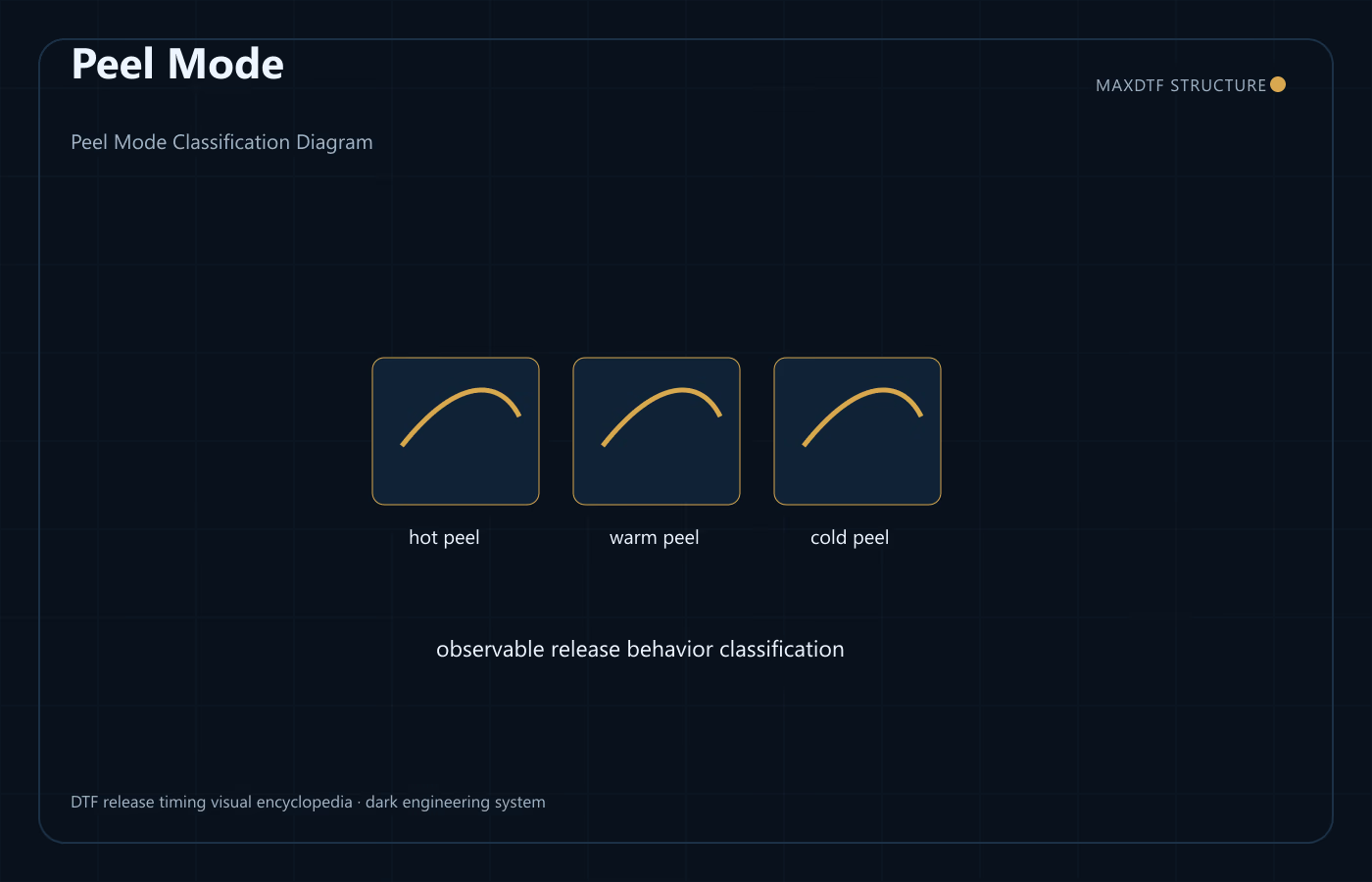
What Is Peel Mode
Peel Mode is the classification of separation behavior based on the observable state of the system at the moment of peeling.
It defines how separation is categorized according to conditions such as thermal state and timing.
Common Peel Modes include:
– hot peel
– warm peel
– cold peel
These modes describe when separation is performed relative to the system condition, not how the system is structured or why separation behaves in a certain way.
How Peel Mode Functions in the DTF System
Within the DTF system, Peel Mode provides a way to classify separation behavior based on observable conditions.
It reflects:
– the state of the system at the moment of peeling
– the timing of separation relative to process conditions
– the classification of separation behavior
Peel Mode operates alongside system-level conditions such as:
– Release Activation State
– Release Readiness State
It also relates to separation behavior defined by:
– Release Force Profil
– Release Uniformity
– Release Stability
– Release Completeness
Peel Mode does not define these behaviors but provides a way to categorize them.
What Peel Mode Does NOT Do
Peel Mode does not define whether a separation interface exists (see Release Layer Definition).
Peel Mode does not define interfacial energy conditions (see Release Surface Energy).
Peel Mode does not define when separation becomes possible (see Release Activation State).
Peel Mode does not define whether the system is ready for stable separation (see Release Readiness State).
Peel Mode does not define force distribution during separation (see Release Force Profil).
Peel Mode does not define whether separation is uniform (see Release Uniformity).
Peel Mode does not define whether separation remains stable (see Release Stability).
Peel Mode does not define whether separation is complete (see Release Completeness, Partial Release Condition, Over-Release Condition).
Peel Mode does not define failure conditions (see Release Failure Boundary).
Peel Mode does not define process parameters such as exact temperature, pressure, or timing values.
Peel Mode does not independently determine separation performance or transfer quality.
Structural Nature
Peel Mode is a classification concept within the DTF system.
It does not describe material properties, system conditions, or force behavior.
Instead, it categorizes separation behavior based on observable system states.
This concept does not define:
– interface structure
– interfacial energy
– activation conditions
– system readiness
– force distribution
It defines only how separation behavior is categorized in practice.
Performance Boundaries
Peel Mode operates within the observable range of system conditions.
Different modes correspond to different system states at the moment of separation.
However, Peel Mode itself does not define whether separation will be stable, uniform, or complete.
These outcomes depend on underlying system conditions.
Peel Mode defines classification boundaries, not performance boundaries.
Common Misunderstandings
Peel Mode is often interpreted as a direct indicator of product performance.
In reality, it is only a classification of separation behavior.
It is also commonly misunderstood as a process instruction.
While terms like hot peel or cold peel may be used operationally, Peel Mode itself does not define how the system should be operated.
Another misunderstanding is that changing Peel Mode alone can control separation outcomes.
Within the DTF system, separation behavior is governed by factors such as Release Activation State, Release Readiness State, and Release Force Profil, not by classification alone.
Where Peel Mode Sits in the System
Peel Mode exists at the classification layer of separation behavior.
It belongs to the Behavior Classification Layer within the Release Timing Architecture in DTF Printing.
Within the system, it provides a framework to describe and categorize separation behavior without defining the underlying mechanisms.
It connects observable separation conditions with system-level behaviors such as:
– Release Uniformity
– Release Stability
– Release Completeness
This concept is part of the Release Timing Architecture in DTF Printing system.